
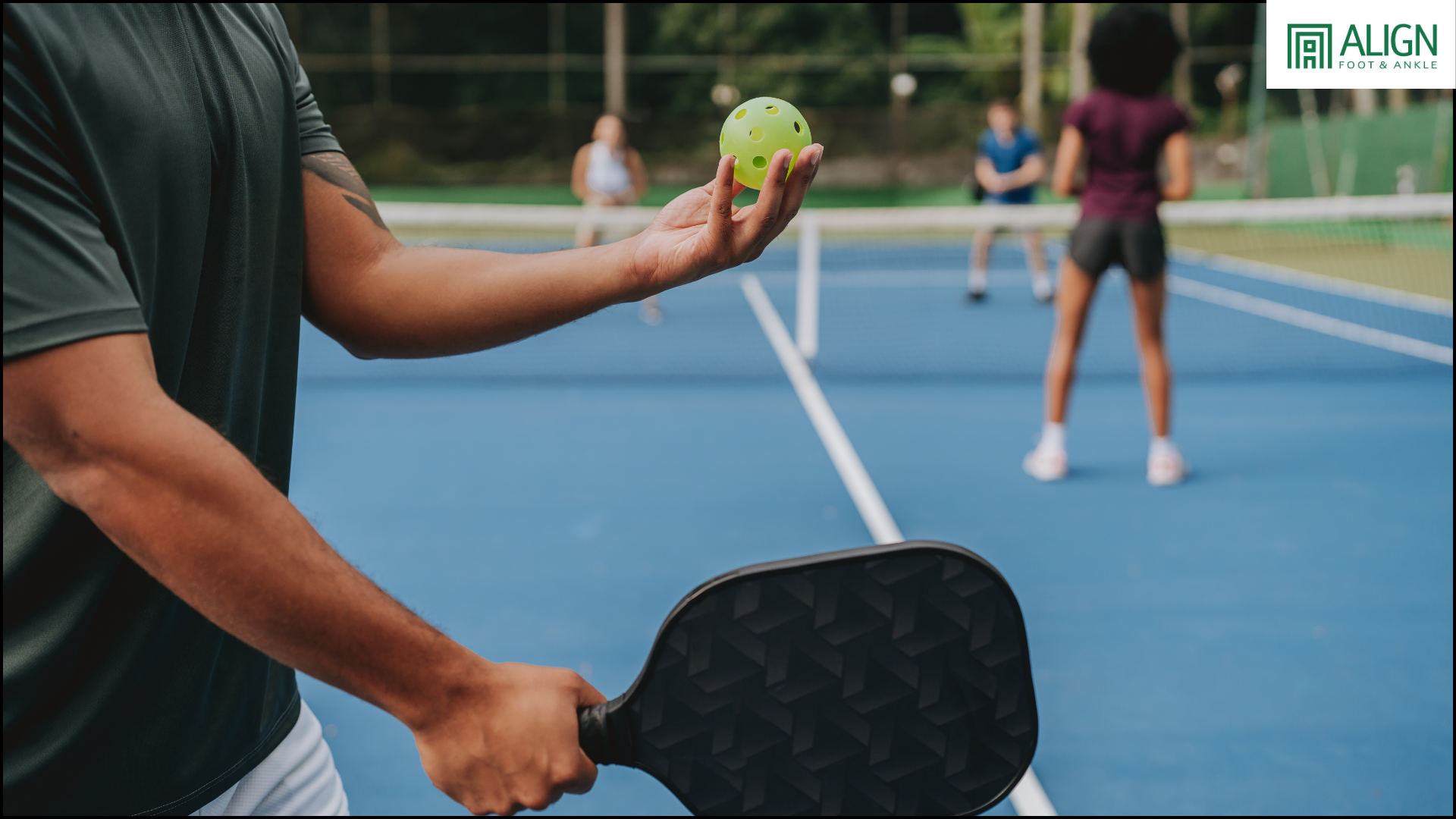
Austin’s Pickleball Season Is Heating Up – And So Are the Foot Injuries That Come With It
Spring in Austin means the courts fill back up fast. Players who took a break over the winter are lacing up again, ramping their game back up – and doing it just as the heat starts building toward triple digits. That combination is exactly when we start seeing the most preventable foot and ankle injuries of the year.
The return-to-activity window is the most vulnerable one
Here’s what happens every spring: someone who played three times a week last fall takes a few months off, feels rested and motivated when the weather turns, and jumps back in at the same intensity they left off. Their cardiovascular fitness catches up quickly. Their tendons and ligaments do not.
Connective tissue – the tendons, fascia, and ligaments that absorb the lateral cuts and explosive pushoffs pickleball demands – adapts slowly. It takes weeks of progressive load to rebuild the tolerance that a winter break erodes. When you skip that buildup and go straight back to full play, you’re asking structures that aren’t ready to perform as if they are.
That gap between perceived readiness and actual tissue readiness is where the injuries live. And in Austin, where spring outdoor conditions can shift from comfortable to brutally hot in a matter of weeks, that window closes faster than players expect.
Then the heat kicks in – and changes everything
Austin doesn’t ease into summer. By May the courts are warm. By June and July, you’re playing on surfaces that radiate heat through your shoes, in air that’s asking your body to work twice as hard just to regulate temperature.
What most players don’t realize is that heat changes how your body handles physical stress at a tissue level. When you’re playing in extreme heat, blood flow gets redirected to your skin to cool you down – which means less circulation reaching your tendons and fascia at the exact moments they need it. Tendons already have poor blood supply under normal conditions. In the heat, that problem compounds significantly.
Dehydration accelerates this further. Even mild dehydration reduces the elasticity of connective tissue – making tendons slightly less pliable, and a tendon that’s less pliable under load is one that’s closer to its breaking point. A player who came back in March already carrying some Achilles tightness, pushed through spring, and is now grinding through July is playing a very different risk game than they realize.
What we see at Align every year
The pattern is predictable: players who return in spring feeling fine start showing up in our office by June and July. The injuries aren’t random, they’re the result of tissue that never fully caught up to the activity demand, compounded by heat that accelerated the breakdown.
Some common conditions we see:
Achilles tendinopathy: An undertrained tendon meets reduced heat-related pliability. A painful combination that often starts as post-match tightness and becomes something that stops you mid-game.
Plantar fasciitis flares: Early spring irritation left unaddressed becomes chronic inflammation by summer. The morning heel pain that was manageable in April is often debilitating by July.
Ankle sprains: Fatigue and heat stress together compromise the reflexes that prevent bad landings. The lateral cuts pickleball demands don’t get safer as the match goes on in 100-degree heat.
Metatarsalgia: Hot court surfaces plus forefoot overload from return-to-sport ramp-up creates ball-of-foot pain that can sideline players for weeks.
How to come back smart this spring
The good news is that the injury pattern is predictable, which means it’s preventable. A few intentional adjustments in how you return to play this spring can make the difference between a strong summer season and sitting one out.
Give your connective tissue four to six weeks to rebuild. Start with shorter sessions and lower intensity, even if you feel ready for more. Tendons need progressive load over time – not just a single good warmup.
Shift your playing times as the heat builds. Austin courts before 9 AM or after 7 PM aren’t just more comfortable – they are meaningfully different for how your body manages tissue stress and recovery.
Hydrate before you get on the court, not during. By the time you feel thirsty mid-match in summer heat, your connective tissue elasticity is already compromised.
Check your footwear. Shoes that carried you through fall need to be reassessed for spring. Lateral support breaks down with mileage, and worn-out court shoes on hot surfaces is a setup for forefoot and ankle problems.
Take early symptoms seriously. Achilles tightness after a spring match that resolves overnight is a signal, not nothing. Ignored through April and May, it often becomes a two-month problem by July.
When the tissue needs more than rest
Rest helps with acute injury. It doesn’t resolve chronic inflammation, and it doesn’t rebuild tissue that’s been breaking down over weeks of accumulated stress. When players come to us after grinding through spring and summer symptoms, the conversation usually isn’t about whether they need treatment – it’s about how much earlier they wish they’d come in.
We work at the tissue level, not just the symptom level. The goal is always to get to the reason the injury keeps happening – and change it.
SoftWave Shockwave Therapy Sound waves stimulate blood flow deep in tendons and fascia – the same structures that heat and chronic overload have essentially choked off. For Achilles tendinopathy and plantar fasciitis, SoftWave breaks the chronic inflammation cycle and restarts the healing process the body keeps attempting but can’t complete on its own.
Class IV Laser Therapy Laser energy penetrates inflamed tissue to calm the inflammatory response at a cellular level and accelerate recovery. For players returning to activity this spring who are managing early soreness, laser therapy compresses the timeline between irritation and full return to play – without just masking pain.
DPMx Regenerative Injections For soft tissue that has accumulated damage through a full season of play – tendons and ligaments that have taken repeated stress without full recovery – DPMx delivers growth factors directly to the injury site to support structural repair. This is for the player whose pain keeps coming back despite doing everything right. It addresses the tissue, not just the discomfort.
Spring is the right time to get ahead of this
The players who have their best Austin summers are the ones who paid attention in spring. If something is already nagging at you as you ramp back up – heel pain in the morning, tightness along the Achilles after a match, soreness in the ball of your foot that takes longer to resolve than it used to – that’s the moment to come in. Not July.
Request a consultation at Align Foot & Ankle. Let’s figure out what’s going on and build a plan that keeps you on the court all season long.
• Phone: 512-882-4911
• Location: 1600 W 1600 W 38th St #408, Austin, TX 78731
Don’t forget to check out our socials for valuable insights and updates:
• Tiktok