
Pain Relief Isn’t the Same as Healing — And the Difference Matters More Than You Think
When something hurts, the goal feels obvious: make it stop.
That’s a reasonable place to start. Pain is disruptive. It changes how you move, how you sleep, how you think about your own body. Getting out of pain is a legitimate and important part of any treatment plan.
But there’s a question worth asking — one that doesn’t come up often enough in the average clinical encounter.
Is the pain going away because the problem is being solved? Or is it going away because the signal is being turned down?
Those are two very different things. And for patients dealing with chronic or recurring foot and ankle conditions, understanding the difference can change everything about how you approach recovery.
What Pain Relief Actually Does
Most conventional treatments for musculoskeletal pain are designed — sometimes explicitly, sometimes by default — to reduce symptoms. That’s not a criticism. It’s just an accurate description of how they work.
Anti-inflammatory medications reduce the inflammatory response in damaged tissue. Corticosteroid injections suppress immune activity at the site of injury. Immobilization reduces mechanical load to give irritated structures a break. Rest removes the stimulus that’s provoking the pain.
All of these approaches have a role. In the right context, each of them is appropriate and sometimes necessary.
But here’s what they share in common: none of them directly stimulate tissue repair. They quiet the response. They don’t rebuild what caused it.
For many patients, this is enough. The body handles the rest on its own. Inflammation resolves. Tissue heals. Pain goes away and stays gone.
But for a significant number of patients — particularly those with chronic conditions, degenerated tissue, or injuries that have been present for months or years — symptom suppression without tissue repair creates a cycle that’s difficult to break. The pain returns. The same treatment is repeated. Temporary relief is followed by another flare. And the underlying structural problem continues, largely unaddressed.
What’s Actually Happening Inside Chronic Tissue
To understand why this matters, it helps to look at what chronic injury actually looks like at the tissue level.
Acute injuries — a fresh sprain, a new stress fracture, a recent tear — trigger an active inflammatory response. The body mobilizes resources. Blood flow increases. Growth factors are released. Cellular repair begins. The system is working.
Chronic injuries are different. Over time, persistently damaged tissue often transitions out of the active inflammatory phase and into a state called tendinosis or degenerative change — depending on the structure involved. The tissue isn’t acutely inflamed anymore. It’s disorganized. Collagen fibers lose their aligned architecture. Vascularity decreases. The cellular environment shifts from one that supports repair to one that’s simply… stalled.
This is why rest alone frequently fails chronic conditions. There’s no active inflammation to resolve. The tissue has already moved past that phase. What it needs isn’t less stimulus — it needs the right kind of stimulus to restart a repair process that has essentially gone dormant.
Anti-inflammatory treatment in this context may actually work against recovery. If the inflammatory response — in the right amount, at the right stage — is part of how tissue heals, suppressing it in already-chronic tissue can remove one of the few remaining signals the body is still sending.
The Difference Tissue Repair Actually Makes
Tissue repair means something specific. It means the structural integrity of the affected tissue is being restored — not just that the pain signals originating from it have been quieted.
For a plantar fascia dealing with chronic fasciopathy, repair means collagen remodeling. The disorganized fiber architecture begins to realign. Tensile strength is restored. The tissue becomes capable of handling load without breaking down.
For a degenerative tendon, repair means cellular reactivation. Tenocytes — the cells responsible for producing and maintaining tendon collagen — are stimulated back into an active state. New collagen is synthesized. Vascularity may return to areas where it had been lost.
For fat pad atrophy — the thinning of the natural cushioning beneath the heel or ball of the foot — repair means restoring the volume and shock-absorbing capacity of a tissue that has been compressed, traumatized, or simply depleted over time.
These outcomes are structurally different from pain relief. They’re also more durable. When tissue heals, the pain doesn’t just go away temporarily — it goes away because there’s nothing left to generate it.
Where Regenerative Medicine Fits In
This is the clinical rationale behind regenerative approaches to musculoskeletal care — and why they represent a meaningful shift in how chronic conditions can be managed.
Rather than working downstream of the problem — reducing inflammation after it occurs, masking pain signals as they arrive — regenerative therapies work upstream. They intervene at the level of the tissue itself, providing the biological signals and mechanical stimulation the body needs to initiate and sustain genuine repair.
At Align, the regenerative modalities we use are chosen specifically because they work with the body’s healing mechanisms, not around them.
SoftWave Shockwave Therapy delivers acoustic waves into damaged tissue, stimulating cellular repair, promoting new blood vessel formation, and reactivating healing responses in tissue that has gone chronically dormant. Patients with plantar fasciitis, Achilles tendinopathy, and other chronic soft tissue conditions often experience both meaningful pain reduction and measurable structural improvement — not because symptoms are suppressed, but because the tissue is actually responding.
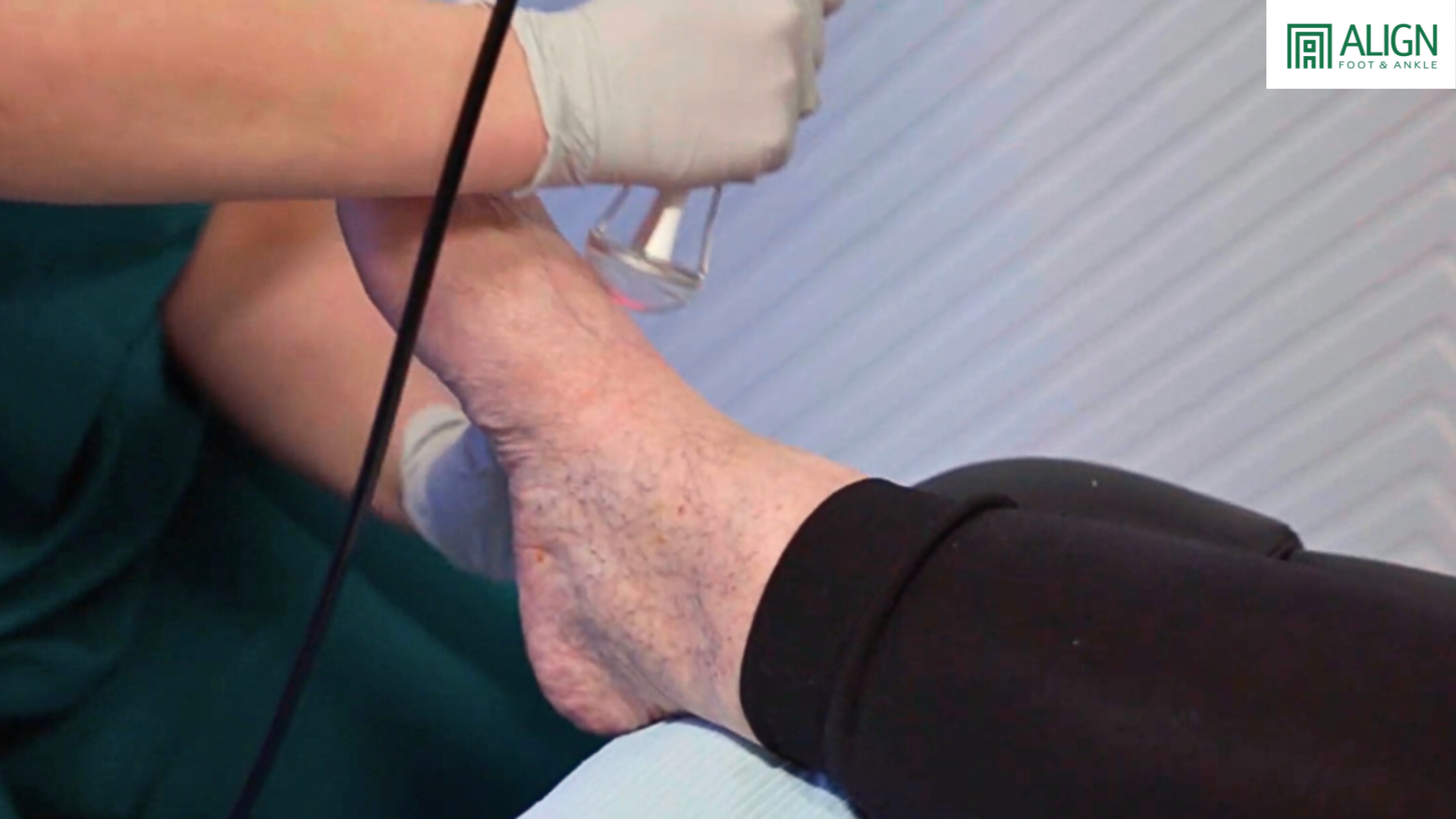
Class IV Laser Therapy uses targeted light energy to accelerate mitochondrial activity and cellular regeneration within damaged tendons, fascia, and surrounding soft tissue. The effect isn’t analgesic in the traditional sense — it’s metabolic. The cells are being given the energy input they need to function and repair more effectively.
DPMx Regenerative Injections introduce concentrated growth factors and signaling proteins directly into the affected tissue. These biologics communicate with local cells, recruiting the repair activity the tissue can no longer generate on its own at adequate levels. The goal is to restore the biological environment that makes healing possible.
Liposana Fat Allograft addresses fat pad atrophy directly — restoring the cushioning and structural volume that has been lost, providing both mechanical protection and the cellular environment needed to support ongoing tissue health.
None of these approaches replaces the mechanical component of recovery. Loading the tissue correctly — progressively, intelligently, at the right phases of healing — remains essential. But these modalities create the biological conditions in which that loading actually produces the repair it’s supposed to.
A Note on Timing
The best time to ask whether your treatment is addressing the source isn’t after months of failed attempts – it’s at the start. Whether you’re two weeks into heel pain or two years in, the question is the same: are we relieving this, or are we repairing it?
There’s a particular patient who comes to mind when this topic comes up — someone who has been dealing with heel pain, or a chronic tendon problem, or recurring forefoot discomfort for a year or more. They’ve rested. They’ve iced. They’ve taken the anti-inflammatories. They may have had a cortisone injection or two that helped briefly before the pain returned.
They haven’t failed treatment. The treatment hasn’t addressed what they actually need.
When the conversation shifts from “how do we reduce your pain” to “how do we repair the tissue that’s generating it,” the approach changes. The timeline changes. And for many patients, so does the outcome.
If you’ve been managing a chronic foot or ankle condition and keep finding yourself back at square one, it may be time to ask whether what you’ve been doing is treating symptoms — and whether there’s a path that addresses the underlying problem instead.
That conversation is one we’re glad to have.
Schedule a consultation today.
Contact Align Foot & Ankle
• Phone: 512-882-4911
• Location: 1600 W 1600 W 38th St #408, Austin, TX 78731
Don’t forget to check out our socials for valuable insights and updates:
• Tiktok