
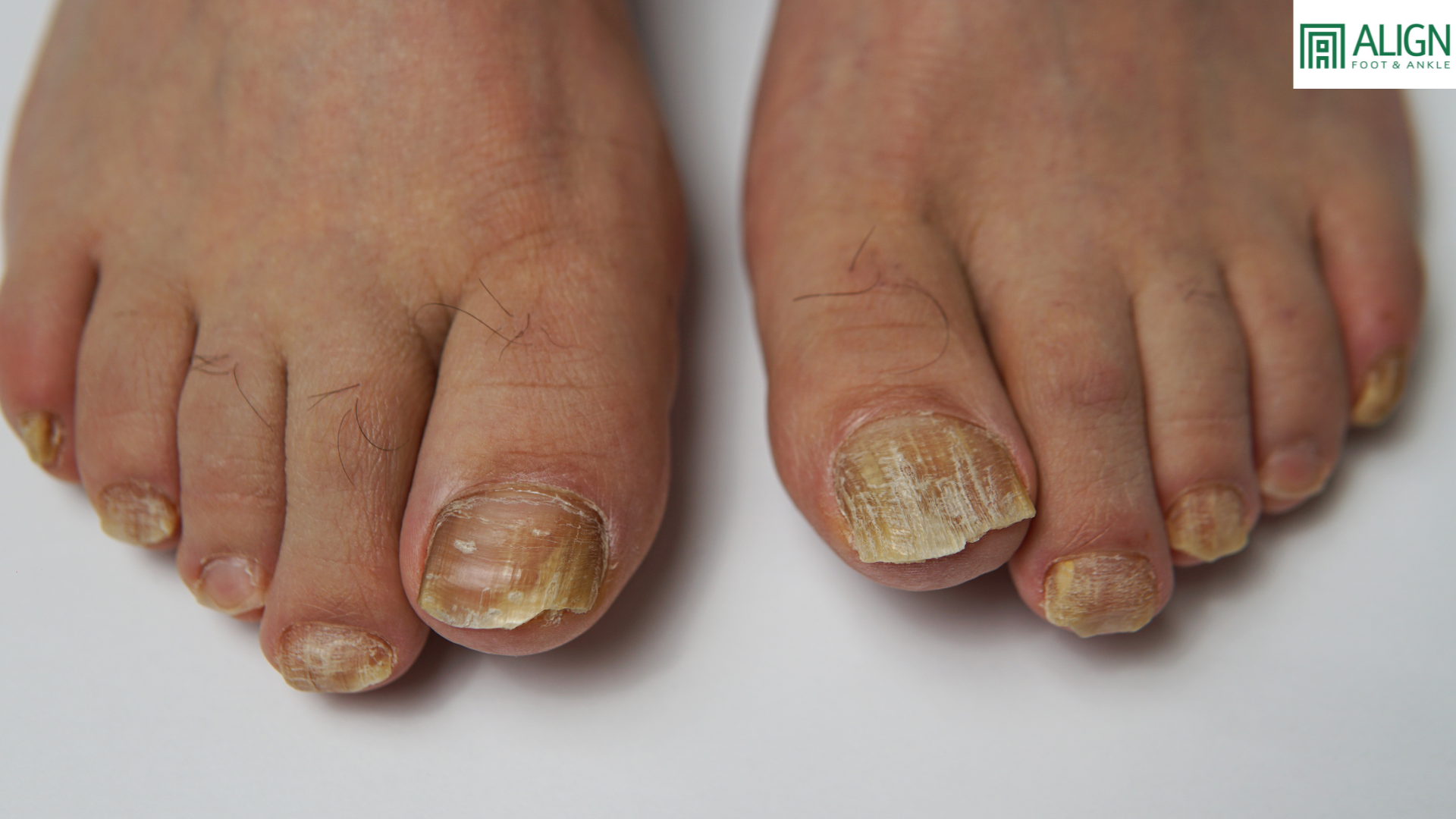
Toenail Fungus Truths: What Actually Works?
Yellow. Thick. Brittle. Crumbly. Difficult to trim.
Toenail fungus is one of those conditions that seems like it should be simple to treat, yet it can be surprisingly stubborn. Many patients have tried an over-the-counter antifungal from the drugstore for months with little improvement, while others have been told that an oral antifungal medication is their only real option.
The truth is somewhere in between.
Today, we have more ways to approach fungal toenails than ever before, including prescription-strength topical treatments, antifungal foot soaks, professional nail care, REMY laser therapy, and even cosmetic nail restoration for nails that have been damaged or distorted.
At Align Foot & Ankle, we often combine treatments because toenail fungus isn’t just a problem on the surface of the nail.
Understanding where the fungus lives, why it keeps coming back, and how a healthy nail grows can make all the difference.
First, Is It Actually Toenail Fungus?
Not every thick, discolored nail is fungal.
Toenails can change in appearance because of repeated trauma from shoes, running or sports, psoriasis, aging, previous nail injuries, and other nail disorders. That is why an accurate diagnosis matters before committing to months of treatment.
True fungal nail infections, also called onychomycosis, commonly cause:
- Yellow, white, or brown discoloration
- Thickening of the nail
- Brittle or crumbly edges
- Debris underneath the nail
- Separation of the nail from the nail bed
- Changes in nail shape
- Difficulty trimming the nail
- Occasionally discomfort or pressure in shoes
And here’s something many patients don’t realize: the skin and the nails are often connected.
Athlete’s foot can serve as a reservoir for fungus, allowing the nail to become reinfected even after treatment. Treating the nail while ignoring fungus on the surrounding skin can be one reason the problem keeps returning.
Truth #1: Toenail Fungus Is Difficult to Treat for a Reason
The nail plate is designed to be protective. Unfortunately, that also makes it difficult for medication applied to the surface to reach organisms living underneath and within the nail.
Toenails also grow very slowly.
Even when treatment is working, the damaged portion of the nail doesn’t suddenly become clear. Instead, we are looking for healthier nail to gradually grow forward from the base.
A great toenail can take approximately 12 to 18 months to completely grow out, which means successful treatment requires patience and consistency.
Think of treatment less like “cleaning” the existing nail and more like creating the best environment possible for a healthier nail to replace it.
Truth #2: Topical Treatment Has Come a Long Way
Topical therapy can play an important role, particularly when fungal involvement is mild to moderate or when it is incorporated into a more comprehensive treatment plan.
At Align, some of the topical options we may recommend include:
CNU Fungal Cream
CNU fungal cream can be used as part of a topical antifungal regimen targeting the nail and surrounding skin.
This is particularly important when there are signs of athlete’s foot or fungal involvement around the toes. Remember, treating the nail but leaving fungus on the skin can create an opportunity for reinfection.
Tolcylen® Topical Solution
Tolcylen is another topical option we use for fungal nails. It is designed specifically for application to the nail and surrounding structures and can be incorporated into a daily home-treatment routine.
With any topical therapy, consistency matters. Sporadic application is unlikely to provide the same opportunity for improvement as following the recommended treatment protocol throughout the nail-growth process.
Tolcylen® Foot Soaks
For some patients, we may also incorporate Tolcylen foot soaks.
Soaks can be particularly helpful when we want to address not only the toenails but also the surrounding skin and spaces between the toes. This broader approach becomes important in patients who have recurrent athlete’s foot or multiple nails affected.
Rather than thinking about fungus as a single “bad nail,” we often think about the entire foot environment.
Truth #3: The REMY Laser Gives Us Another Way to Approach the Nail
One of the advanced options available at Align Foot & Ankle is REMY laser therapy for fungal toenails.
The REMY laser allows us to deliver controlled laser energy through the nail plate and to the tissues beneath it without removing the nail.
Why is that important?
Topical products have to work from the outside of the nail. Laser therapy gives us another way to address the affected nail as part of a comprehensive treatment plan.
Treatment is performed in the office, requires no injections or anesthesia, and typically allows patients to return to their normal activities immediately afterward.
Laser therapy also avoids the systemic medication exposure associated with oral antifungal medications, making it an option worth discussing for patients who prefer a non-oral approach or who may not be good candidates for systemic therapy.
But there is something important to understand about laser treatment:
It doesn’t make an abnormal nail instantly look normal.
The damaged portion of the nail still has to grow out. Our goal is to treat the fungal nail while creating the best opportunity for healthier-looking nail to gradually grow forward from the base.
Truth #4: Sometimes the Best Treatment Isn’t Just One Treatment
One of the biggest misconceptions about toenail fungus is that there should be a single magic treatment.
For many patients, we prefer a multi-modal approach.
Depending on the severity of the infection, the number of nails involved, the condition of the surrounding skin, and previous treatment attempts, a plan might include:
Professional nail reduction + REMY laser therapy + daily topical treatment + antifungal foot soaks + shoe and skin hygiene
Each component addresses a different part of the problem.
Professional thinning of a thick nail can make the nail easier to manage and may improve access for topical treatments. Topical products provide ongoing treatment at home. Foot soaks help us address the broader foot environment. The REMY laser provides an additional in-office treatment modality.
Instead of asking, “Which treatment is best?” we often ask:
“Which combination makes the most sense for this particular nail?”
Truth #5: Treating the Fungus and Restoring the Nail’s Appearance Aren’t Always the Same Thing
This is something that often gets overlooked.
Even while a fungal nail is being treated, the existing nail may remain thick, damaged, irregular, discolored, or partially missing while we wait for new nail growth.
For patients who are bothered by the appearance of the nail, we may also offer KeryFlex Nail Restoration.
KeryFlex uses a flexible, medical-grade resin to create a natural-looking artificial nail over the existing nail structure. It can improve the cosmetic appearance of nails that have been damaged or distorted by fungal infection, trauma, or other nail conditions.
The restored nail is designed to look and feel more like a natural toenail and can provide a cosmetic improvement while the underlying nail continues to grow.
KeryFlex may be considered for nails affected by:
- Previous fungal infection
- Trauma-related nail damage
- Thickened or irregular nails
- Discoloration
- Partial nail loss or deformity
- Cosmetic changes following treatment of an ingrown nail
It’s important to understand that KeryFlex is nail restoration, not antifungal treatment. If an active fungal infection is present, we still need to address the underlying condition.
For some patients, that means we can work toward two goals at the same time: improving nail health while also helping the nail look better during the process.
Truth #6: Your Shoes May Be Part of the Problem
You can treat your toenails perfectly and still overlook an important potential source of reinfection: your shoes.
Fungus thrives in warm, dark, moist environments, which makes the inside of a frequently worn shoe an environment where fungal organisms may persist.
During treatment, we may recommend:
- Rotating shoes rather than wearing the same pair every day
- Allowing shoes to dry completely between uses
- Changing socks regularly, particularly after exercise
- Keeping feet clean and dry
- Treating athlete’s foot promptly
- Avoiding walking barefoot in communal showers, locker rooms, and pool areas
- Keeping nail clippers and pedicure tools clean
- Avoiding sharing nail tools with other people
These steps may seem simple, but preventing reinfection is part of treating the infection.
Truth #7: The Earlier You Treat It, the Better
A small area of discoloration at the edge of one nail is very different from a severely thickened nail that has been abnormal for years.
As fungal involvement progresses, more of the nail plate and nail bed may become involved, and treatment can become more challenging.
If you notice a nail beginning to change color, thicken, crumble, or lift away from the nail bed, it is worth having it evaluated rather than waiting until the entire nail is affected.
And remember: not every abnormal nail is fungus. The sooner we determine what is actually causing the change, the sooner we can recommend an appropriate treatment plan.
What About Oral Antifungal Medication?
Oral antifungal medications remain an option for certain patients and can be effective, but they aren’t the right choice for everyone.
Medical history, other medications, potential interactions, and the risks and benefits of systemic treatment all need to be considered.
For patients who want to avoid oral medication or who aren’t appropriate candidates, today’s topical and device-based treatments give us additional ways to approach fungal nails.
The Align Approach: Treat the Nail AND Its Environment
At Align Foot & Ankle, our approach to toenail fungus isn’t simply to hand you a bottle and tell you to come back in a year.
We look at the nail, surrounding skin, severity of involvement, previous treatments, footwear, recurrence risk, and your individual goals.
From there, we can build a treatment plan that may incorporate professional nail care, CNU fungal cream, Tolcylen topical therapy, Tolcylen foot soaks, REMY laser therapy, strategies to reduce reinfection, and KeryFlex Nail Restoration when cosmetic restoration is appropriate.
Most importantly, we set realistic expectations.
Toenail fungus didn’t develop overnight, and a healthy nail won’t grow back overnight either. Successful treatment requires addressing the fungal environment while giving the new nail time to grow.
And while we’re waiting for that healthier nail to grow, you don’t necessarily have to spend the next year hiding your toes. For appropriate patients, KeryFlex can help restore a more natural-looking nail during that process.
Ready to Stop Guessing What’s Going on With Your Toenails?
If you’ve been buying antifungal products, hiding your toenails under polish, or simply hoping they’ll eventually clear on their own, it may be time for a different approach.
Schedule a fungal nail evaluation at Align Foot & Ankle to find out what’s causing your nail changes and which treatment options may be appropriate for you.
Whether the goal is treating an active fungal infection, preventing recurrence, restoring the appearance of a damaged nail, or all three, the right diagnosis is where it starts.
Clearer, healthier-looking nails start with the right diagnosis and the right plan.
Align Foot & Ankle
Where Innovation Meets Movement.™
Schedule a consultation today.
Contact Align Foot & Ankle
• Phone: 512-882-4911
• Location: 1600 W 1600 W 38th St #408, Austin, TX 78731
Don’t forget to check out our socials for valuable insights and updates:
• Tiktok