
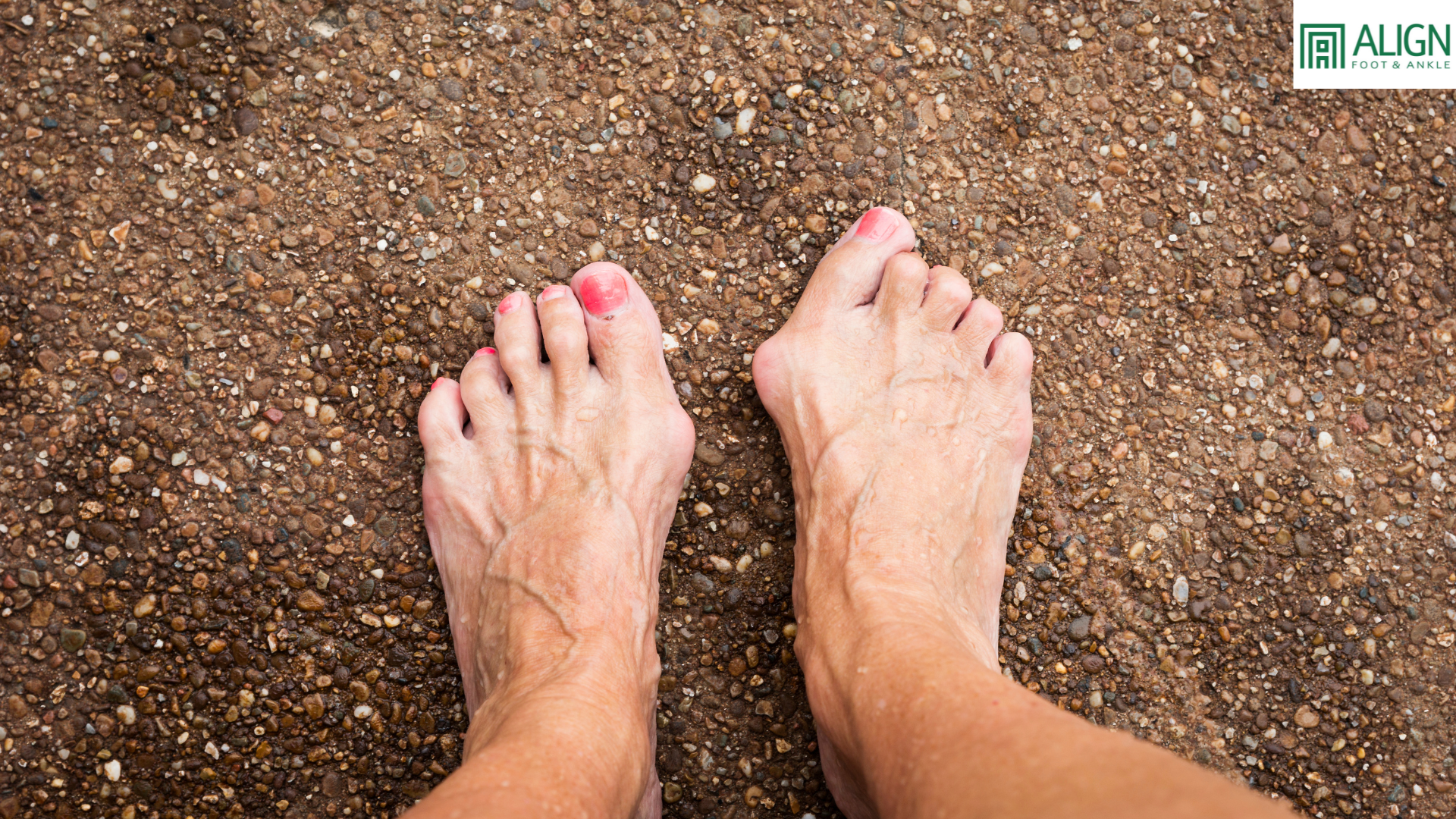
Why Do Bunions and Hammertoes Get Worse Over Time?
If you have a bunion or hammertoe, you may feel like it appeared out of nowhere.
Maybe your big toe has slowly started drifting toward your other toes. Maybe your second toe is beginning to curl or rub against your shoe. Or perhaps you’ve noticed that a bump that never used to bother you is suddenly making certain shoes uncomfortable.
The truth is, bunions and hammertoes do not develop overnight. They are progressive structural changes that typically develop over years as the way your foot is built and the way it moves begin to influence alignment.
And while shoes may not be the original cause, the wrong shoes can do more than aggravate the symptoms. They may contribute to the deformity progressing faster by repeatedly increasing pressure on an already mechanically vulnerable foot.
You May Inherit the Foot Type, Not the Bunion
One of the biggest misconceptions about bunions is that they are caused solely by shoes.
Genetics can absolutely play a role, but you don’t necessarily inherit a bunion itself. What you may inherit is the foot structure and mechanics that make a bunion more likely to develop.
Flat feet, low arches, excessive flexibility, certain joint alignments, and other biomechanical characteristics can change how pressure moves through the foot with every step.
One step may not matter much. But think about how many steps you take in a day, then multiply that by years or decades.
Over time, those repetitive forces can gradually contribute to changes in the position of the bones and joints.
Why Bunions and Hammertoes Often Show Up Together
It is very common for us to see a patient who has both a bunion and one or more hammertoes.
That isn’t necessarily a coincidence.
As a bunion progresses, the big toe begins drifting toward the smaller toes. This can create crowding in the forefoot and change the way pressure is distributed when you stand and walk.
The second toe often takes the brunt of it.
As the big toe moves over, the smaller toes may begin losing the space they need to remain properly aligned. Combined with changes in the muscles and tendons controlling the toes, a toe can gradually begin to bend or contract.
What started as one alignment problem can eventually affect the rest of the forefoot.
Muscles and Tendons Matter Too
Your toes aren’t held straight by bones alone.
A complex system of muscles, tendons, ligaments, and joints works together to stabilize the foot and control movement. When those forces become imbalanced, some structures may begin pulling harder than others.
Over time, that imbalance can cause a toe to buckle or a joint to move out of its ideal position.
Early hammertoes may still be flexible, meaning the toe can be manually straightened. As the deformity progresses, however, the joint can become increasingly stiff or rigid.
That is one reason we encourage patients to have changing toe alignment evaluated before it becomes severely painful.
So, Do Shoes Cause Bunions and Hammertoes?
Not exactly, but they can play a bigger role than simply making them hurt.
Shoes generally aren’t the only reason someone develops a bunion or hammertoe. The underlying structure and mechanics of the foot are important. But when a foot is already predisposed to these deformities, certain shoes can repeatedly reinforce the forces pushing the toes out of alignment and potentially contribute to faster progression.
Think about a narrow or pointed toe box. Every time you put your foot into that shoe, the toes are being compressed together. If the big toe is already beginning to drift toward the second toe, that repeated crowding isn’t simply uncomfortable. It places additional pressure in the same direction the deformity is already moving.
High heels can add another problem by shifting more of your body weight toward the front of the foot. That increases pressure across the forefoot and can further crowd the toes into the front of the shoe.
Over a few hours, you may simply notice soreness. But repeated over months and years, those additional forces can matter.
So while shoes may not have started the problem, they can potentially accelerate a problem that was already developing.
That doesn’t mean you can never wear a heel or a fashionable shoe. It’s about understanding your foot structure, choosing footwear wisely, and balancing style with what your feet are telling you.
Shoes with adequate width, appropriate support, and enough room for the toes can help reduce unnecessary pressure on a foot that is already prone to deformity.
Why They Seem to Get Worse With Age
Bunions and hammertoes are progressive deformities.
Unlike a blister or minor strain, the underlying structural changes don’t simply disappear after a few days of rest. The same forces that contributed to the problem continue acting on the foot every time you stand and walk.
Add years of repetitive pressure, changes in muscle and tendon balance, and footwear that continually crowds or overloads the forefoot, and the deformity may continue to progress.
That doesn’t mean every bunion or hammertoe will progress at the same rate or that everyone will eventually need surgery.
It does mean that changes in alignment are worth paying attention to, particularly if you begin noticing:
- Increasing pain or inflammation
- Difficulty finding comfortable shoes
- Corns or calluses where the toes rub
- Pain beneath the ball of the foot
- A second toe beginning to lift, curl, or cross over
- Increasing stiffness in a toe
- Changes in balance or the way you walk
- Activities becoming limited because of foot pain
Treatment Isn’t Just About the Bump
At Align Foot & Ankle, we look beyond what is visible on the outside of the foot.
We want to understand why the deformity is occurring, how your foot is functioning, where abnormal pressure is developing, and how much the condition is affecting your life.
For some patients, treatment may begin conservatively with footwear modifications, custom orthotics, padding, activity modifications, or other therapies designed to improve comfort and address contributing biomechanics.
And footwear isn’t only about pain relief. Choosing the right shoe can also help reduce some of the external forces that may be contributing to continued progression.
When a deformity becomes painful, progressive, or begins interfering with daily activities, surgical correction may be appropriate. Minimally invasive surgical techniques can allow us, in appropriately selected patients, to correct bunions and hammertoes through very small incisions while minimizing disruption to the surrounding soft tissues.
The goal isn’t simply to make a foot look straighter.
It’s to improve alignment, function, comfort, and movement.
Don’t Wait Until Your Shoes Stop Fitting
If you’ve noticed your big toe beginning to drift, your toes starting to curl, or your shoes becoming increasingly uncomfortable, you don’t have to wait until the problem becomes severe to have it evaluated.
Understanding your foot mechanics early can help you make better decisions about footwear, support, treatment, and when intervention may be appropriate.
Because when it comes to bunions and hammertoes, what you see on the outside of the foot is often only part of the story.