
Anatomy of an Orthotic: Why One Size Doesn’t Always Fit All
Walk into almost any pharmacy, sporting goods store, or shoe store and you’ll find an entire wall of shoe inserts promising more cushioning, better support, and relief from foot pain.
And for some people, an over-the-counter insert may be enough.
But when foot pain keeps coming back, when alignment is part of the problem, or when the way your foot moves is placing stress on other structures, one size doesn’t always fit all.
That couldn’t be more true when it comes to orthotics.
First, What Is an Orthotic?
An orthotic is more than something soft that goes inside your shoe.
A properly designed foot orthotic is intended to interact with the way your foot meets the ground. Depending on its design, it can help support alignment, redistribute pressure, improve the way forces travel through the foot, and reduce excessive stress on painful or overloaded structures.
Think of your feet as the foundation of your body. Every step begins there.
When that foundation isn’t functioning efficiently, the effects aren’t always limited to the feet. Changes in foot mechanics can influence the ankle, knee, hip, and the way the entire lower extremity moves.
That’s why orthotics aren’t just for older adults or people who already have significant foot problems. Children, athletes, active adults, people who stand all day for work, and older adults may all benefit from additional support when their individual mechanics call for it.
Anatomy of an Orthotic
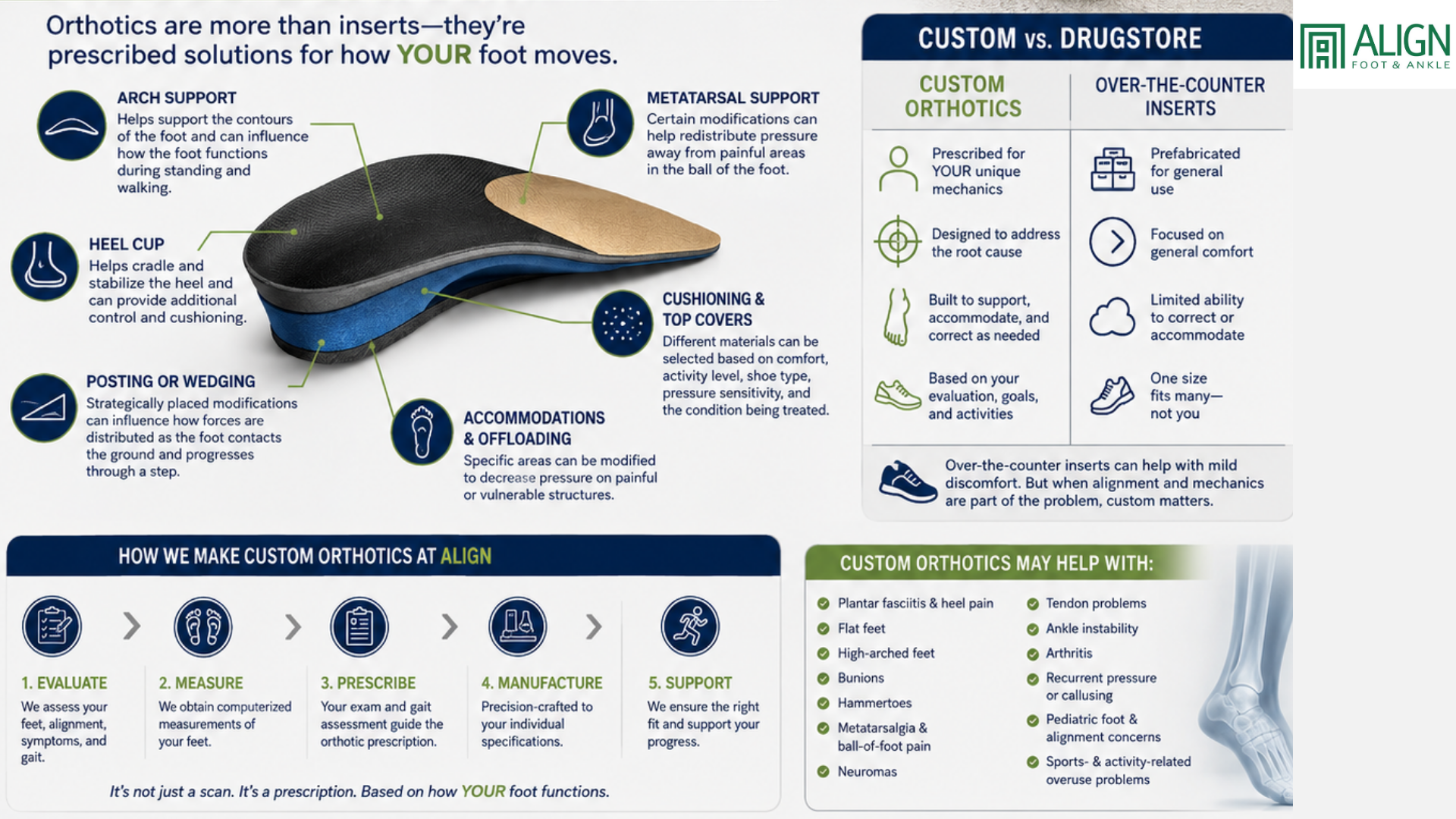
Not all orthotics are built the same, and different components serve different purposes.
Depending on the patient’s needs, an orthotic may incorporate:
Arch support
Helps support the contours of the foot and can influence how the foot functions during standing and walking.
Heel cup
Helps cradle and stabilize the heel and can provide additional control and cushioning.
Posting or wedging
Strategically placed modifications can influence how forces are distributed as the foot contacts the ground and progresses through a step.
Metatarsal support
Certain modifications can help redistribute pressure away from painful areas in the ball of the foot.
Cushioning and top covers
Different materials can be selected based on comfort, activity level, shoe type, pressure sensitivity, and the condition being treated.
Accommodations and offloading
Specific areas can be modified to decrease pressure on painful or vulnerable structures.
The important part isn’t simply having these features. It’s determining which features a particular foot actually needs, where they should be placed, and how much correction or accommodation is appropriate.
Custom Orthotics vs. Drugstore Inserts
Over-the-counter inserts aren’t necessarily bad.
For someone looking for additional cushioning or mild generalized support, a quality prefabricated insert may be perfectly reasonable. They’re accessible, relatively inexpensive, and can sometimes provide meaningful symptom relief.
The limitation is right in the name: they’re prefabricated.
They weren’t made for your foot.
Two people can wear the same size shoe and have completely different arch heights, heel positions, pressure patterns, gait mechanics, activities, and reasons for experiencing pain.
That’s where custom orthotics are different.
A custom orthotic isn’t selected from a shelf based primarily on shoe size. It is prescribed around the individual patient.
How We Make Custom Orthotics at Align
At Align Foot & Ankle, the process starts with understanding why you’re having the problem in the first place.
We evaluate your feet, alignment, symptoms, and areas of pain. We also look at the way you stand and walk, because a foot sitting still doesn’t always tell us what happens when you’re actually moving.
We consider your:
- Foot structure and alignment
- Gait and biomechanics
- Areas of pain or excessive pressure
- Specific diagnosis or condition
- Activity level
- Work and exercise demands
- Typical shoes
- Treatment goals
We then obtain computerized measurements of your feet. Those measurements are used to manufacture an orthotic to your individual specifications.
But the scan is only part of the process.
The prescription matters just as much as the scan.
Based on what we find during your examination and gait assessment, specific modifications can be incorporated into the orthotic to support, accommodate, redistribute pressure, or influence mechanics where needed.
In other words, we’re not simply making an insert shaped like your foot. We’re prescribing a device based on how your foot functions.
What Can Custom Orthotics Help With?
Depending on the patient’s individual mechanics and diagnosis, custom orthotics may be incorporated into the treatment of conditions such as:
- Plantar fasciitis and heel pain
- Flat feet
- High-arched feet
- Bunions
- Hammertoes
- Metatarsalgia and ball-of-foot pain
- Neuromas
- Tendon problems
- Ankle instability
- Arthritis
- Recurrent areas of excessive pressure or callusing
- Certain pediatric foot and alignment concerns
- Sports- and activity-related overuse problems
Orthotics aren’t meant to be a cure for every foot problem, and not every patient needs a custom device. The goal is to determine whether abnormal mechanics or pressure are contributing to the problem and, if so, how we can address them.
Why Treat the Mechanics?
Pain tells us where something hurts.
It doesn’t always tell us why it keeps getting irritated.
We can calm down inflammation and treat painful tissue, but if every step continues to place the same excessive load on that tissue, the underlying mechanical stress may still be there.
That’s why at Align, we often look at both sides of the equation:
Treat the painful tissue. Address the forces acting on it.
For the right patient, a custom orthotic can become part of that second piece.
And sometimes the biggest difference isn’t adding more cushion beneath the foot.
It’s changing how the foot interacts with the ground in the first place.
Not Sure Whether You Need Custom Orthotics?
You don’t have to decide before you come in.
At Align Foot & Ankle, we’ll evaluate your foot structure, gait, symptoms, activities, and footwear to determine whether an over-the-counter insert may be sufficient or whether a custom orthotic would better address your individual needs.
Because when it comes to your feet, one size doesn’t always fit all.
Align Foot & Ankle
Where Innovation Meets Movement.™
Schedule a consultation today.
Contact Align Foot & Ankle
• Phone: 512-882-4911
• Location: 1600 W 1600 W 38th St #408, Austin, TX 78731
Don’t forget to check out our socials for valuable insights and updates:
• Tiktok