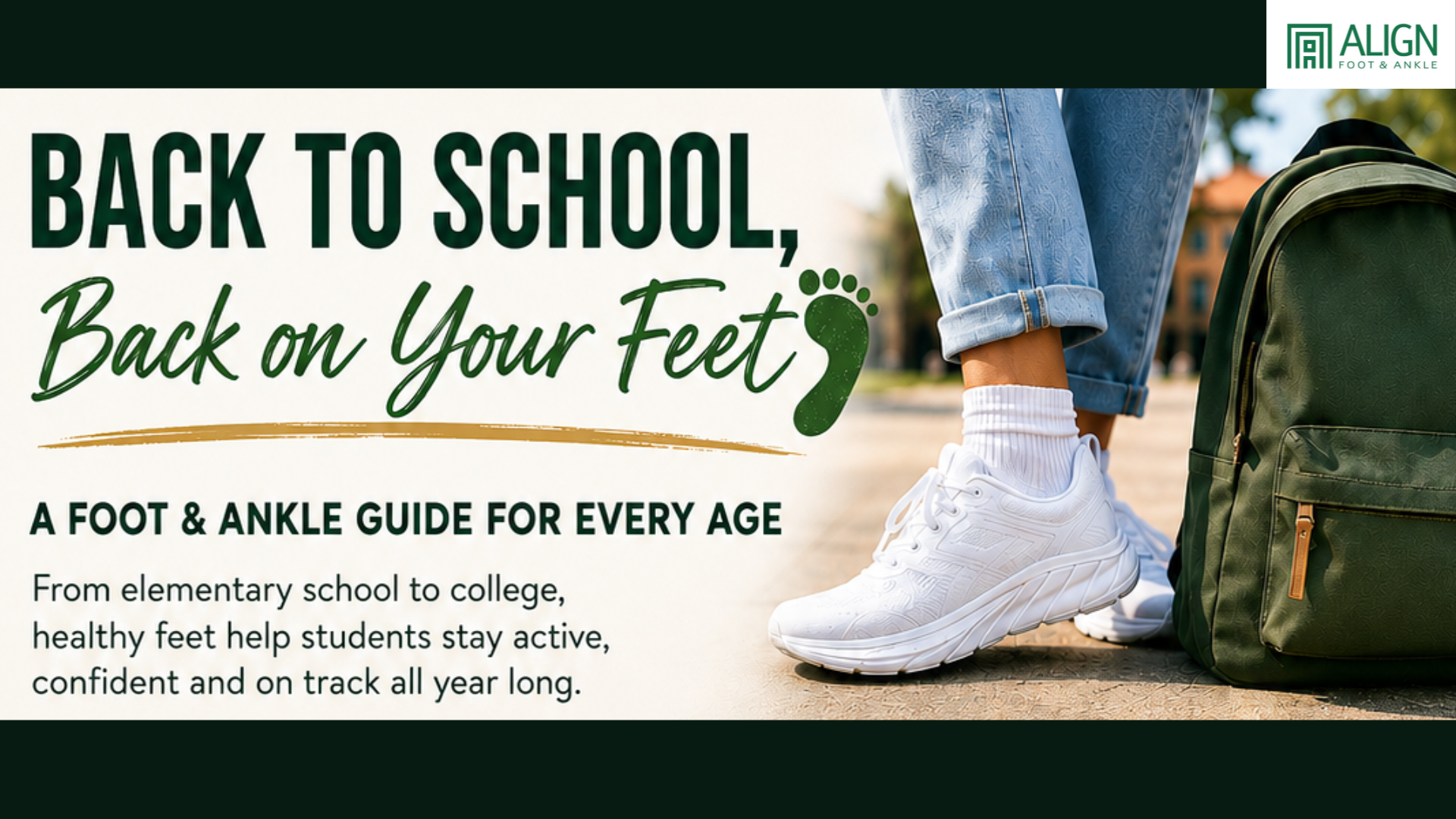
Back to School, Back on Your Feet: A Foot & Ankle Guide for Every Age
Back-to-school season usually means new schedules, new backpacks, new shoes and a lot more time on your feet.
What we sometimes forget is just how much a student’s activity level changes almost overnight.
Elementary school kids go from summer schedules back to recess, PE and sports. Middle and high school athletes jump into practices, games and marching band. College students may suddenly be walking several miles a day across campus.
And here in Austin, if you’re headed back to UT, those miles add up quickly.
At Align Foot & Ankle, this is also the time of year when we start seeing foot and ankle problems that weren’t necessarily noticeable during the summer.
For Parents: Pay Attention to More Than “My Feet Hurt”
Kids don’t always describe foot pain very well. Sometimes the first sign of a problem isn’t a complaint of pain at all.
Watch for:
- Limping or changing the way they walk
- Frequently asking to be carried after activity
- Avoiding sports or activities they normally enjoy
- Wearing out one side of a shoe much faster than the other
- Complaining of heel pain after practice or recess
- Tripping frequently
- Walking with the feet significantly turned inward or outward
- Pain around the inside of the foot or ankle
- Recurrent ankle sprains
- Redness, blisters or pressure points from shoes
Growing pains may be common, but persistent or activity-limiting foot pain deserves a closer look.
Common Problems We See in Younger Students
Heel pain
One of the most common causes of heel pain in active, growing children is calcaneal apophysitis, often called Sever’s disease. It tends to become more noticeable during periods of rapid growth and increased sports activity.
Flat feet
Not every flat foot needs treatment. But if a child’s foot structure is associated with pain, fatigue, abnormal shoe wear or difficulty keeping up with activities, it may be worth evaluating their biomechanics.
Accessory navicular pain
Some children have an extra bone along the inside of the foot called an accessory navicular. It may never cause a problem, but increased activity or certain shoes can irritate the area.
Bunions and hammertoes
Yes, we see these in children and teenagers too. Family history and foot structure can play a significant role, which is why simply telling a child to “wear wider shoes” may not tell the whole story.
Middle School & High School: The Jump in Sports Matters
The transition back into school athletics can be a big one.
Football, soccer, volleyball, cross-country, tennis, cheer, dance and marching band can dramatically increase the amount of repetitive stress going through the feet and ankles.
A common mistake is waiting until an athlete can no longer participate before addressing the problem.
Pain is information.
Recurring heel pain, Achilles pain, shin pain, arch pain or pain at the ball of the foot can be a sign that the athlete’s workload, footwear and biomechanics aren’t working well together.
Early evaluation gives us the opportunity to look at the entire picture, including flexibility, strength, foot structure, gait, training load and shoes.
College Students: Campus Walking Is a Workout
If your student is heading to the University of Texas, they may be surprised by how much walking becomes part of everyday life.
Walking from West Campus to class, crossing the Forty Acres multiple times a day, standing at football games and then going out afterward can be a very different workload than summer.
Add Austin heat and a backpack, and your feet are doing a lot of work.
The shoes that look great for the first day of class may not feel so great after several thousand steps.
The College Shoe Rotation
You don’t have to give up the shoes you like.
Instead, think about having a rotation.
Have a supportive walking shoe for long campus days. Save flatter, less supportive or dressier shoes for days when you aren’t covering as much ground. If you know you’ll be standing for hours, plan accordingly.
Your feet don’t care whether the shoe is trendy. They care about what you’re asking them to do while you’re wearing it.
Don’t Forget About Toenails, Warts and Athlete’s Foot
Back-to-school season also means locker rooms, communal showers, dorms and shared spaces.
A few simple habits can help:
- Wear shower shoes in dorm and gym showers.
- Don’t share shoes, socks or nail clippers.
- Change out of sweaty socks after practice.
- Let athletic shoes dry completely between uses when possible.
- Don’t ignore an itchy or peeling rash between the toes.
- Avoid picking at plantar warts.
- Trim toenails straight across rather than digging into the corners.
And if a toenail starts changing color, thickening or becoming painful, don’t automatically assume it’s fungus. Trauma from sports and repetitive shoe pressure can create similar changes.
Before You Buy New School Shoes
Kids’ feet grow quickly, so don’t assume last year’s size is still correct.
Check the fit while your child is standing. There should be adequate room at the toes without excessive sliding at the heel.
Also remember that shoe size is only one part of fit.
Width, shape, cushioning, stability, heel-to-toe drop and how the shoe interacts with your child’s individual foot structure can all matter.
For athletes, the shoe should also match the activity. A running shoe, court shoe and cleat are designed for very different types of movement.
What About Orthotics?
Not every child needs orthotics.
When we recommend them, it isn’t simply because a foot “looks flat.” We look at how the foot functions during gait, where excessive pressure is occurring, whether symptoms are present and how the mechanics of the foot may be contributing to the problem.
The goal isn’t to make every foot look the same.
The goal is to help that individual foot function as efficiently and comfortably as possible.
Start the School Year Strong
Whether your child is starting elementary school, trying out for a middle school team, heading into varsity athletics or walking across the UT campus for the first time, their feet are the foundation for everything they’re about to do.
Don’t wait until pain sidelines them.
Sometimes a shoe change is enough. Sometimes stretching, activity modification or biomechanical support can make the difference. And sometimes pain is telling us there is something that needs a closer look.
At Align Foot & Ankle, we believe in understanding why something hurts before deciding how to treat it.
Because back to school should mean getting back to learning, sports, friends and everything that comes with a new year, not sitting on the sidelines because your feet hurt.
Where Innovation Meets Movement.
Schedule a consultation today.
Contact Align Foot & Ankle
• Phone: 512-882-4911
• Location: 1600 W 1600 W 38th St #408, Austin, TX 78731
Don’t forget to check out our socials for valuable insights and updates:
• Tiktok