
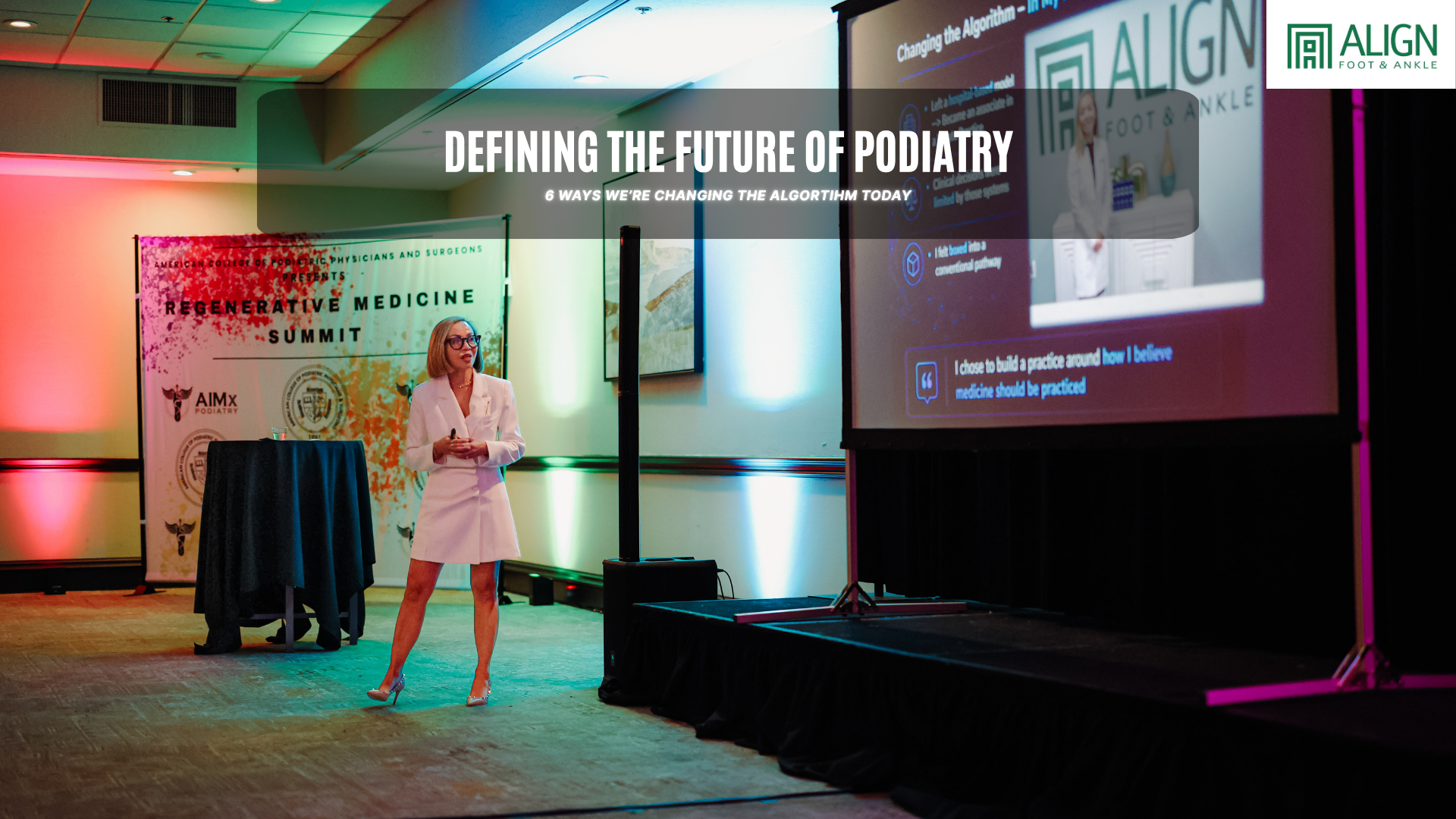
The Future of Podiatry Is Already Here: 6 Ways We’re Changing the Algorithm
Podiatry is changing.
But the future of foot and ankle care isn’t something we have to wait for.
Many of the changes that will define where our profession is going are things we can begin implementing right now.
Not because of one new device, injection, surgical technique or piece of technology. The bigger shift is happening in how we think about treating patients and how we put all of these tools together.
For years, foot and ankle care followed a fairly predictable algorithm: diagnose the problem, start with conservative care, wait for it to fail, try an injection, and eventually discuss surgery.
At Align Foot and Ankle, we’ve been working to change that algorithm.
Here are six ways we’re approaching foot and ankle care differently today, and why we believe they will help shape what podiatry looks like tomorrow.
1. Moving Regenerative Medicine Earlier in the Treatment Algorithm
One of the biggest changes we’ve made is when we intervene.
Historically, many advanced treatment options were reserved for chronic conditions that had already failed months of conservative care.
But why wait until a tissue problem becomes chronic before we become more intentional about supporting recovery?
Today, we may incorporate extracorporeal shockwave therapy, photobiomodulation, orthobiologics and other regenerative modalities earlier, alongside appropriate biomechanical and mechanical treatment.
The goal isn’t to replace traditional podiatric care. It’s to rethink the sequence.
Instead of simply asking, “What do we try next if this fails?” we’re asking, “What can we do now to create the best environment for this patient to recover?”
That change is already happening.
2. Making Surgery Less Disruptive
Surgery isn’t going away, nor should it.
But we can rethink how we perform it.
In appropriately selected patients, minimally invasive techniques allow us to correct certain deformities through much smaller incisions with less disruption of the surrounding soft tissues.
We’re also questioning how much hardware is truly necessary, where procedures need to be performed and how quickly patients can safely return to movement.
At Align Foot and Ankle, the goal isn’t necessarily less surgery.
It’s more thoughtful surgery with less unnecessary disruption.
And that’s something we can offer patients today.
3. Building Treatment Systems Instead of Looking for the “One Thing”
There is no magic laser.
No magic injection.
No magic surgery.
No magic orthotic.
Most chronic foot and ankle problems are more complicated than that.
A patient may have abnormal biomechanics, poor tissue quality, persistent inflammation, weakness, inadequate loading, poor footwear and a structural deformity all contributing to the same symptoms.
That’s why treating the pathology alone isn’t always enough.
We also have to ask: What does this tissue need in order to heal?
That may mean improving the mechanical environment around the tissue. It may mean improving circulation, cellular signaling or loading. It may mean using regenerative modalities to support the tissue while simultaneously correcting the biomechanical forces that contributed to the problem in the first place.
Instead of asking which single treatment is best, we’re increasingly asking which combination of treatments makes the most sense for this particular patient.
It may mean treating the tissue first and correcting the structure later. Or it may mean doing both at the same time.
The future will increasingly involve multimodal treatment plans where therapies complement one another rather than compete with one another.
4. Looking Beyond the X-Ray and the Diagnosis
Imaging will always be important, but structure doesn’t tell us everything.
A normal X-ray doesn’t mean a patient has normal function.
And an abnormal MRI doesn’t necessarily explain why someone hurts.
Today, we have more ways to understand the patient in front of us through diagnostic ultrasound, vascular testing, neurologic and sudomotor testing, biomechanical assessment and, in appropriate situations, laboratory evaluation.
But looking beyond the X-ray also means looking beyond the pathology itself.
A diagnosis tells us what is wrong. It doesn’t always tell us why the tissue isn’t recovering.
We want to understand the mechanical environment, tissue quality, circulation, neurologic function, activity demands and other factors that may be affecting that patient’s ability to heal.
We’re also becoming more intentional about measuring outcomes instead of simply asking, “Does it feel better?”
The goal is no longer just identifying the diagnosis.
We want to understand why this particular patient developed the problem and what may be preventing recovery.
5. Extending Treatment Beyond the Office
Some of the most important parts of a patient’s treatment plan happen when they aren’t in our office.
Home photobiomodulation, stretching, strengthening, footwear modification, orthotics, activity modification and recovery strategies allow patients to participate in their own care every day.
We’re also beginning to think differently about how we can support the biology of healing outside the office.
In appropriately selected patients, that may include therapies such as peptides, which are transforming podiatry by acting as powerful biological signals that accelerate tendon healing, soothe inflammation, and fast-track wound recovery, as part of a broader recovery strategy. Rather than viewing recovery as something that only happens during an office treatment, the goal is to create an environment that continues to support tissue recovery between visits.
Wearable technology, home-based therapies and better outcome tracking will only expand those possibilities.
But we don’t have to wait for the next generation of technology to change the relationship between physician and patient.
We can do that now.
Instead of simply doing something to a patient, we can build a recovery strategy with them.
6. Replacing the Standard Algorithm With the Individual Patient
Two patients can walk into my office with the exact same diagnosis and leave with completely different treatment plans.
And they probably should.
A 25-year-old runner with plantar fasciitis isn’t the same patient as a 72-year-old with plantar fasciitis.
Their biomechanics may be different.
Their tissue quality may be different.
Their activity demands are different.
Their goals are different.
And their capacity for recovery may be different.
So why should their treatment automatically be the same?
Personalized medicine doesn’t have to be some distant concept.
It starts with looking beyond the diagnosis and treating the individual patient standing in front of us.
We Don’t Have to Wait for the Future of Podiatry
Whenever we talk about the future of medicine, it’s tempting to focus on what’s coming next.
The newest technology.
The newest treatment.
The newest procedure.
But I think the bigger opportunity is what we choose to do with the tools we already have.
We can intervene earlier.
We can evaluate more than structure.
We can look beyond the pathology and ask what the tissue needs to recover.
We can address biomechanics and tissue health together.
We can support recovery both inside and outside the office.
We can combine therapies thoughtfully instead of treating them as isolated options.
We can make surgery less disruptive when surgery is necessary.
And we can build treatment plans around patients instead of forcing patients into predetermined algorithms.
The future of podiatry isn’t something we have to wait for.
We’re building it now.
That’s what we mean when we talk about changing the algorithm.
And the more we’re willing to rethink that algorithm today, the more possibilities we’ll create for how we treat patients tomorrow.
Schedule a consultation today.
Contact Align Foot & Ankle
• Phone: 512-882-4911
• Location: 1600 W 1600 W 38th St #408, Austin, TX 78731
Don’t forget to check out our socials for valuable insights and updates:
• Tiktok