It’s Not You. It’s Your Biomechanics.
Valentine’s Day is filled with breakups, makeups, and relationship advice.
But if you’re dealing with foot pain, let’s clarify something first:
It may not be you.
It may be your biomechanics.
Every week, patients walk into Align Foot & Ankle Clinic feeling frustrated with themselves.
“I must be walking wrong.”
“I didn’t stretch enough.”
“I just have bad feet.”
“I’m getting older.”
In most cases, that isn’t the real issue.
Foot pain is often structural and mechanical — meaning the way your foot is built determines how force moves through it. Over time, those forces either distribute evenly… or they concentrate in the wrong places.
And when force is concentrated, tissue breaks down.
What Are Biomechanics?
Biomechanics is how your bones, joints, tendons, and ligaments interact when you move.
It includes:
- Arch height
- Heel alignment
- Forefoot position
- Toe length and orientation
- Tendon strength
- Joint flexibility
- The way your foot strikes the ground
You can have strong muscles and still have structural mechanics that predispose you to problems.
What Exacerbates Poor Biomechanics?
Certain factors magnify underlying structural tendencies:
Narrow Toe Box Shoes
They accelerate bunion progression, compress nerves, and worsen overlapping toes.
High Heel Pitch
Shifts body weight forward, increasing forefoot pressure and Achilles tightness.
Lack of Arch Support
Allows excessive pronation, straining the plantar fascia and posterior tibial tendon.
Pregnancy
Hormonal ligament laxity can permanently alter arch structure.
Rapid Increase in Activity
Training for a race or trip without structural support overloads tissue.
Hard Surfaces
Concrete amplifies ground reaction forces.
Genetic Structure
Metatarsus adductus, flatfoot, high arches, or skewfoot deformity all influence force distribution.
Ignoring Early Symptoms
Pain that “comes and goes” is often repetitive stress that never fully heals.
You cannot stretch your way out of a structural alignment issue.
You cannot foam roll away a bunion.
You cannot strengthen your way out of bone position.
What We Do at Align
We don’t start with a generic protocol.
We start with structure.
At Align Foot & Ankle Clinic, evaluation includes:
- Detailed biomechanical assessment
- Gait analysis
- Structural mapping of deformity
- Functional testing
From there, treatment is tailored.
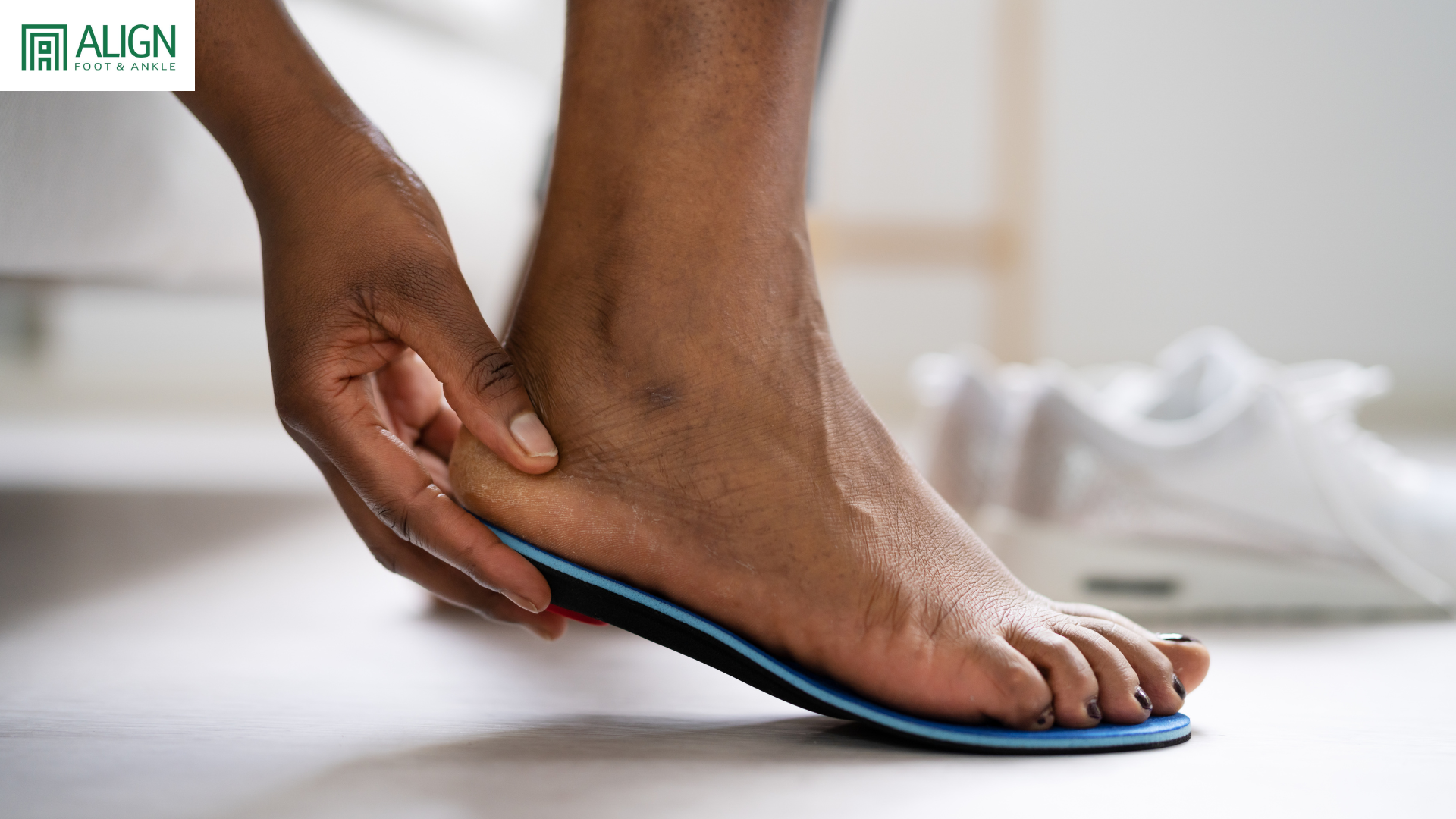
Custom Orthotics
Precision-designed support to correct force distribution and improve alignment.
Class IV Laser Therapy
Reduces inflammation and stimulates tissue repair at the cellular level.
Shockwave Therapy
Activates healing in chronically overloaded tissue.
Red Light Photobiomodulation
Improves circulation and cellular function without heat, ideal for patients with neuropathy or vascular compromise.
Biologic Regenerative Injections
Stimulate tissue repair for tendons, fascia, and joints that have stalled in the healing process.
Minimally Invasive Structural Correction
When alignment must be corrected, we use techniques designed for less tissue disruption and faster recovery — often allowing patients to walk the same day in a boot or post-op shoe.
The Real Shift
When structure improves, symptoms often follow.
When alignment is supported, inflammation decreases.
When force is distributed properly, tissue can finally heal.
This is not about blame.
It’s about understanding how your body is built and treating it strategically instead of reactively.
This Valentine’s season, if your feet have been frustrating you, consider the possibility that:
It’s not you.
It’s your biomechanics.
And biomechanics can be evaluated, supported, and corrected.
Contact Align Foot & Ankle
- Phone: 512-882-4911
- Location: 1600 W 1600 W 38th St #408, Austin, TX 78731
Don’t forget to check out our socials for valuable insights and updates: