
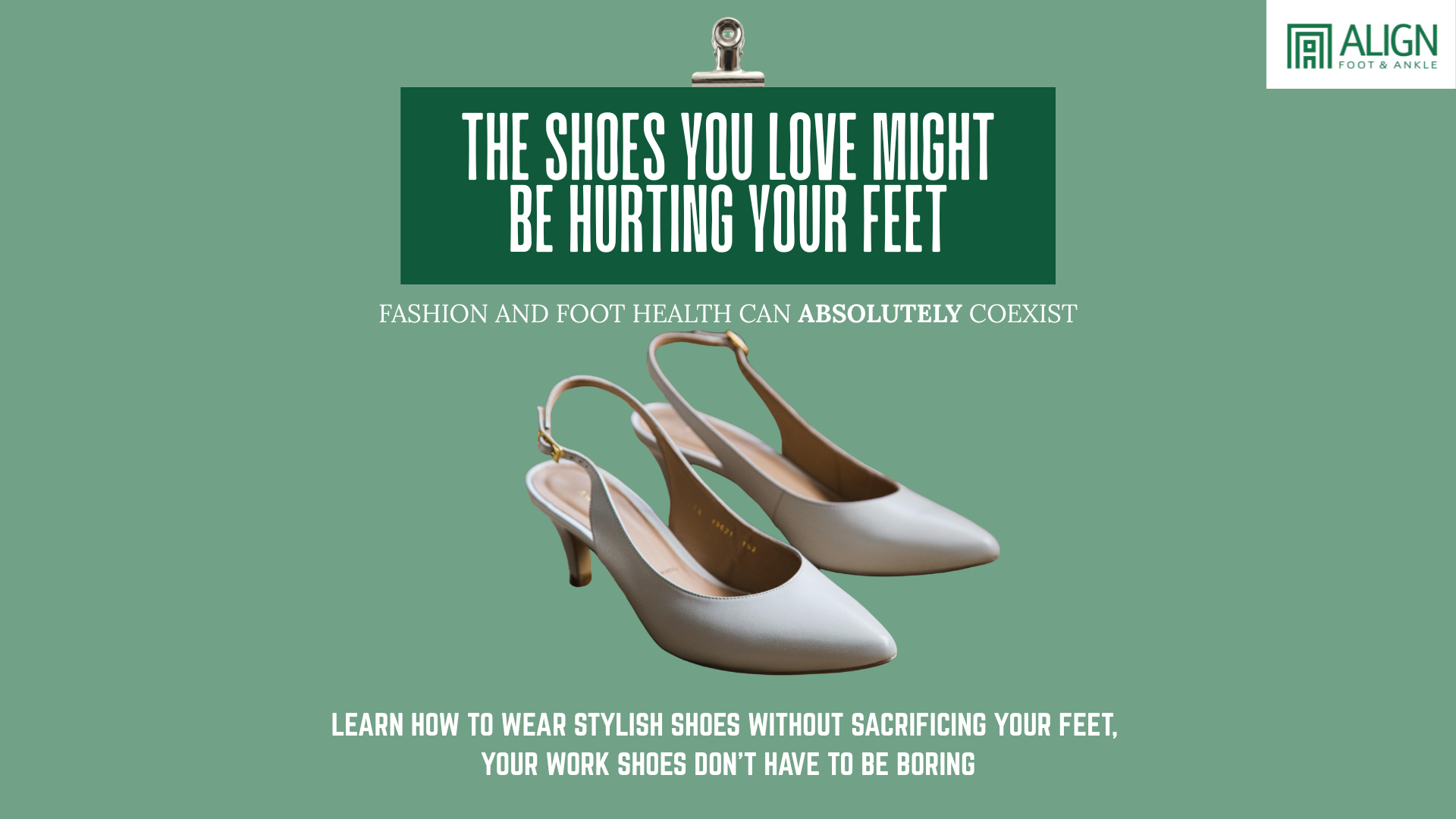
The Shoes You Love May Be Hurting Your Feet
What Your Favorite Shoes May Be Doing to Your Feet
Let’s be honest.
Most of us have bought a pair of shoes knowing they probably weren’t the most comfortable.
The sleek heels.
The trendy sandals.
The pointed-toe flats.
The stylish boots.
We buy them because they look good.
There’s nothing wrong with that.
The problem is when fashion becomes an everyday habit. Over time, the shoes we love can slowly change the way our feet function, often long before we ever notice pain.
Beauty Comes at a Cost
Unlike your clothes, your feet absorb every step you take.
Whether you’re walking through the grocery store, chasing kids, standing at work, or going out for dinner, your feet are carrying your entire body thousands of times each day.
When a shoe changes how your body naturally distributes that force, extra stress gets placed on certain joints, tendons, and nerves.
Those changes don’t usually happen overnight.
They happen gradually, one step at a time.
The High Heel Effect
High heels shift your center of gravity forward, placing significantly more pressure on the ball of your foot.
The higher the heel, the greater the pressure.
A traditional three-inch heel can place nearly 75% of your body weight onto the front of your foot. Over time, that increased load can contribute to:
- Pain in the ball of the foot (metatarsalgia)
- Neuromas
- Hammertoes
- Bunions
- Thinning of the protective fat pad beneath the forefoot
- Increased tightness of the Achilles tendon
That doesn’t mean you can never wear heels.
It simply means they probably shouldn’t be your everyday shoe.
The Pointed Toe Problem
Many fashionable shoes become narrower toward the front.
Unfortunately, your toes don’t.
Your forefoot is naturally designed to spread out as you walk, helping with balance, stability, and shock absorption.
When your toes are repeatedly squeezed into a narrow toe box, it can contribute to:
- Bunions
- Hammertoes
- Overlapping toes
- Corns and calluses
- Nerve irritation
The occasional night out isn’t usually the problem.
It’s years of wearing the same narrow shoes day after day that often leads to structural changes.
The Hidden Cost Isn’t Always Pain
One of the biggest misconceptions we hear is:
“My feet don’t hurt, so everything must be okay.”
In reality, many foot conditions develop quietly.
We frequently meet patients who say:
“I’ve had this bunion for years. It never bothered me until recently.”
The bunion wasn’t new.
The pain was.
By the time symptoms appear, the structural changes have often been developing for years.
Finding the Right Balance
This isn’t a blog about throwing away every stylish pair of shoes you own.
Life is meant to be enjoyed.
The goal is simply making smarter footwear choices most of the time so your feet can handle those special occasions.
Here are a few recommendations we commonly share with our patients.
Keep Heel Height Reasonable
For everyday wear, try to keep heel height around one and half inch or less whenever possible.
This places less stress on the forefoot and helps your body maintain a more natural walking pattern.
Love High Heels? Choose Platforms
If you prefer a taller heel, consider a platform shoe.
For example, a two-inch heel with a one-inch platform under the front of the shoe creates only about a one-inch difference—or “pitch”—between your heel and forefoot.
Your foot experiences much less stress than it would in a traditional two-inch heel.
Narrow Toe Shoes Are Okay…in Moderation
You don’t have to give up pointed-toe shoes forever.
Instead, think of them like dessert.
Enjoy them occasionally, but don’t make them your everyday choice.
Whenever possible, rotate into shoes with a wider toe box to give your toes room to spread naturally.
Choose Stability Over Flexibility
A good shoe should support your foot, not fold in half.
Shoes that are extremely flexible through the middle often provide very little support and can place additional strain on the foot over time.
Likewise, a wider block heel generally offers better stability than a thin stiletto.
Know Your Foot Type
There isn’t one perfect shoe for everyone.
People with flatter, more pronated feet often do well with a supportive shoe that has a slight heel and good arch support.
On the other hand, people with very high arches tend to absorb more shock. Even small heels can become unstable because the foot is already “supinated” or positioned in a higher arch. For these individuals, a platform or wedge-style shoe like “flatforms” often provides better cushioning or shock absorption, while still allowing for a fashionable look.
Fashion and Foot Health Can Coexist
You don’t have to choose between looking good and taking care of your feet.
The key is moderation.
Save the higher heels for special occasions.
Rotate your footwear throughout the week.
Choose shoes that support your feet whenever possible.
And if you’re beginning to notice a bunion, hammertoe, pain in the ball of your foot, or persistent discomfort, don’t ignore it just because it’s “not that bad yet.” Call us to schedule an appointment and help you get back to living in comfort again.
At Align Foot & Ankle, our goal isn’t to tell you what you can and can’t wear.
It’s to help you stay active, comfortable, and confident—so you can enjoy the shoes you love without sacrificing your long-term mobility.
Schedule a consultation today.
Contact Align Foot & Ankle
• Phone: 512-882-4911
• Location: 1600 W 1600 W 38th St #408, Austin, TX 78731
Don’t forget to check out our socials for valuable insights and updates:
• Tiktok