
What Makes the REMY Class IV Laser Different?
When patients hear that we offer Class IV laser therapy, one of the first questions they ask is:
“Isn’t every laser basically the same?”
The short answer is no.
Just like not every ultrasound, MRI, or surgical instrument is identical, not every Class IV laser is built the same. The technology matters—but just as importantly, how that technology is used matters.
At Align Foot & Ankle, we chose the 45-watt REMY Quad Class IV laser because it combines four therapeutic wavelengths of light into a single treatment session, allowing us to treat multiple tissue depths simultaneously instead of relying on one wavelength to do everything.
Understanding Wavelengths
Think of wavelengths like different tools in a toolbox.
Each wavelength interacts with tissue differently. Some are better suited for the skin, others target nerves or tendons, while others penetrate more deeply into muscles and joints.
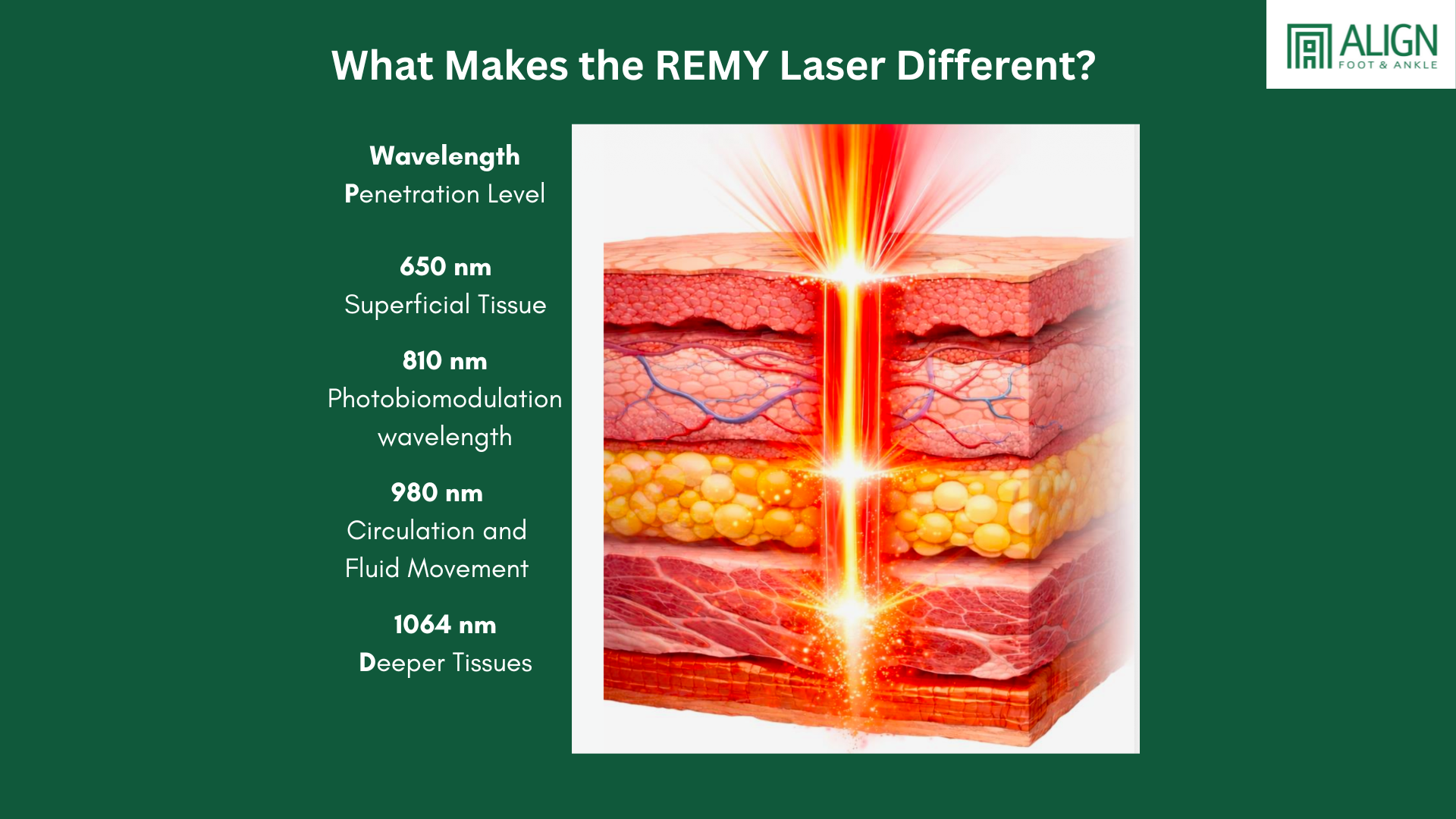
Rather than depending on a single wavelength, the REMY Quad combines 650 nm, 810 nm, 980 nm, and 1064 nm, allowing multiple tissue layers to be addressed during the same treatment.
650 nm: Surface Healing
The 650 nm wavelength primarily works within the most superficial layers of tissue.
It supports the skin and small blood vessels, making it useful for promoting healthy tissue repair and epithelial healing.
This wavelength is commonly used for:
- Surgical incisions
- Wounds and ulcers
- Burns
- Superficial inflammation
- Skin healing
810 nm: Cellular Repair & Photobiomodulation
The 810 nm wavelength is often considered one of the primary photobiomodulation wavelengths.
It interacts efficiently with the mitochondria—the “energy factories” inside our cells—to support ATP production while producing very little heat.
Because of this, it is commonly used for:
- Peripheral neuropathy
- Tendon injuries
- Muscle injuries
- Ligament conditions
- Joint pain
- Chronic musculoskeletal conditions
980 nm: Pain Relief & Circulation
Unlike the 810 nm wavelength, the 980 nm wavelength has a stronger interaction with water and hemoglobin within tissues.
Clinically, this can help support:
- Improved circulation
- Muscle relaxation
- Temporary pain relief
- Acute soft tissue injuries
- Trigger points
- Fungal nail treatments
It also produces a controlled therapeutic warming effect while remaining comfortable for patients.
1064 nm: Deep Tissue Penetration
The 1064 nm wavelength penetrates deeper into the body with less absorption by surface pigment, allowing energy to reach larger muscles, deeper tendons, ligaments, and joints.
This makes it especially useful for conditions involving:
- Arthritis
- Chronic tendon disorders
- Deep muscle injuries
- Large joints
- Persistent musculoskeletal pain
Why Does Using Four Wavelengths Matter?
Most foot and ankle conditions don’t involve just one structure.
Take plantar fasciitis as an example.
While many people think of it as simply irritation of the plantar fascia, the reality is often much more complex. Pain may involve the fascia itself, surrounding muscles, connective tissue, nerves, blood vessels, and deeper supporting structures.
The same concept applies to many other conditions we treat, including:
- Achilles tendinopathy
- Tendon injuries
- Arthritis
- Muscle strains
- Ligament injuries
- Chronic foot and ankle pain
Because different tissues absorb different wavelengths of light, combining multiple wavelengths allows us to engage multiple tissue layers during a single treatment rather than depending on one wavelength to accomplish every goal.
A simple way to think about it is:
- 650 nm: Surface healing.
- 810 nm: Cellular repair and photobiomodulation.
- 980 nm: Pain relief, circulation, and controlled therapeutic heat.
- 1064 nm: Deep penetration for larger muscles, tendons, and joints.
Together, these wavelengths provide greater flexibility than a single-wavelength laser because different tissues respond to different portions of the light spectrum.
But Wavelength Isn’t the Whole Story
One of the biggest misconceptions about laser therapy is that simply buying the “best” laser automatically produces the best results.
That’s not how photobiomodulation works.
The wavelength is only one piece of the equation.
Clinical outcomes are also influenced by:
- Power density (the amount of energy delivered over a specific area)
- Energy dose
- Treatment time
- Treatment frequency
- The condition being treated
- Proper patient selection
Power density is especially important because it helps determine whether enough energy reaches the tissue to stimulate a meaningful biological response while remaining comfortable for the patient.
In other words, the laser is a tool. How that tool is applied is just as important as the technology itself.
Why We Chose the REMY Quad
When we evaluated different laser systems, we wanted more than just a powerful device.
We wanted a platform that offered:
- Four complementary wavelengths in one treatment
- High power output for efficient energy delivery
- Comfortable treatments for patients
- The flexibility to address a wide variety of foot and ankle conditions
The REMY Quad allows us to customize treatments based on each patient’s diagnosis while engaging multiple tissue layers in a single session.
Every Patient Is Different
No two patients—and no two injuries—are exactly alike.
That’s why we don’t believe in a one-size-fits-all approach.
For some patients, Class IV laser therapy may be used on its own. For others, it may be incorporated into a broader treatment plan that can include custom orthotics, extracorporeal shockwave therapy, biologic injections when appropriate, rehabilitation exercises, or minimally invasive procedures.
The goal is never simply to use the newest technology.
The goal is to choose the right treatment, for the right patient, at the right time.
Because that’s what leads to thoughtful, individualized care.
If you’re experiencing foot or ankle pain and are wondering whether Class IV laser therapy may be appropriate for your condition, our team would be happy to discuss your options and determine whether it may be an appropriate part of your personalized treatment plan.
Schedule a consultation today.
Contact Align Foot & Ankle
• Phone: 512-882-4911
• Location: 1600 W 1600 W 38th St #408, Austin, TX 78731
Don’t forget to check out our socials for valuable insights and updates:
• Tiktok