Why We Sometimes Treat the Tissue Before the Structure
When something hurts in your foot or ankle, it’s easy to assume there must be something structurally wrong that needs to be fixed.
A torn tendon.
Arthritis in a joint.
A damaged ligament.
A thickened plantar fascia.
A bunion that’s getting worse.
And sometimes, structure absolutely is the problem.
But one of the biggest shifts in how we approach foot and ankle care at Align is recognizing that what we see structurally is only part of the story.
Before we decide how to treat the structure, we also want to understand two other things:
What is happening to the tissue?
And just as importantly:
Why is that tissue being stressed in the first place?
That’s where regenerative medicine and biomechanics come together.
Structure Doesn’t Always Tell Us the Whole Story
An X-ray, MRI, or ultrasound can give us incredibly valuable information. It can show arthritis, a tear, degeneration, changes in the plantar fascia, or abnormalities in the position of a bone or joint.
But an image doesn’t always explain why one person hurts and another person with a similar finding doesn’t.
That’s because your foot isn’t a static structure. It moves.
Every step you take creates forces that travel through the foot, ankle, knee, and the rest of the lower extremity. How your foot absorbs those forces can influence which tissues become overloaded over time.
So when we evaluate a painful condition, we’re not only asking:
“What’s damaged?”
We’re also asking:
“Why did it become damaged?”
That second question can completely change the treatment plan.
This Is Where Biomechanics Matters
Biomechanics is simply the study of how your body moves and how forces are distributed during movement.
Your foot contains 26 bones, 33 joints, and a complex network of muscles, tendons, ligaments, and fascia. All of those structures have to work together every time you stand, walk, run, or exercise.
A small mechanical imbalance can create thousands of repetitive stresses over time.
For example, if the way your foot moves continually places excessive tension on the plantar fascia, treating the painful fascia without addressing that mechanical stress may only solve part of the problem.
The same concept applies to Achilles tendon problems, posterior tibial tendon dysfunction, forefoot pain, arthritis, plantar plate injuries, and many other conditions we treat.
That’s why your treatment plan may include more than treating the exact spot that hurts.
We may look at your foot type, joint motion, gait, shoes, activity level, strength, flexibility, and how pressure is distributed across the foot.
Sometimes we recommend stretching or strengthening.
Sometimes footwear changes make a significant difference.
Sometimes custom orthotics are used to help redistribute forces and improve the way the foot functions.
And sometimes we combine those mechanical changes with treatments designed to support the injured tissue itself.
Treat the Tissue AND Change the Environment
This is where our approach becomes different.
If a tendon, ligament, fascia, or joint has been irritated for months or even years, simply telling someone to rest may not be enough.
Likewise, correcting biomechanics without addressing a chronically painful tissue may not be enough either.
Sometimes we need to do both.
Depending on the diagnosis, we may incorporate therapies such as SoftWave, Class IV laser therapy, biomechanical support, and regenerative treatment options.
Each has a different role.
SoftWave uses acoustic energy to stimulate a biological response within the tissue.
Class IV laser therapy uses specific wavelengths of light to support cellular energy production, circulation, and tissue recovery.
We may also use biomechanical treatments, including custom orthotics, to change how forces are being placed across the injured area.
And in appropriately selected patients, we may incorporate biologic tissue products such as DPMx umbilical cord tissue allograft as an adjunct to the overall treatment plan.
The important word is adjunct.
DPMx isn’t a magic injection, and we don’t present it that way.
It’s one tool we may use as part of a larger strategy designed to support the local tissue environment while we simultaneously address the mechanical forces contributing to the problem.
Steroid Injections May Reduce the Pain, But What Is Causing It?
Steroid injections have traditionally been used for many painful foot and ankle conditions because they can reduce inflammation and provide temporary pain relief.
But reducing pain and addressing the reason the tissue became painful are not necessarily the same thing.
If a steroid injection quiets the symptoms but the same tendon, fascia, ligament, or joint continues to experience abnormal stress with every step, the underlying problem may still be there.
That’s an important distinction.
Our goal isn’t simply to mask pain. We want to understand why the tissue is hurting in the first place and what we can do to change the environment around it.
That’s also why not all injections should be viewed the same way.
When we incorporate a biologic tissue product such as DPMx umbilical cord tissue allograft, we’re using it for a very different purpose. It may be incorporated as an adjunct to support the local tissue environment as part of a broader treatment plan.
But that doesn’t mean we can ignore biomechanics.
A laser can’t correct a mechanical deformity.
SoftWave can’t change the alignment of a bone.
And even when we’re supporting the tissue with a biologic treatment, we still have to ask why that tissue became overloaded in the first place.
If abnormal mechanics continue to stress the same area thousands of times every day, we’ve only addressed part of the problem.
That’s why regenerative medicine, in our opinion, shouldn’t exist in a vacuum.
We have to look at the entire patient.
What does the tissue need?
How is the foot functioning?
What mechanical forces are contributing to the problem?
And is there a structural abnormality that ultimately needs to be corrected?
Those questions help us decide what comes next.
When Does Structure Become the Priority?
There are absolutely situations where the structural problem is significant enough that correcting it becomes necessary.
A painful bunion is still a structural deformity.
Advanced arthritis may eventually require surgical treatment.
A significant tendon or ligament injury may not respond adequately to conservative care.
And regenerative treatments cannot simply make every structural problem disappear.
That’s where surgery may become the right answer.
But even then, we believe there is value in thinking about tissue health and biomechanics.
If surgery corrects a structure but we ignore the forces that contributed to the problem, we’re still missing part of the picture.
Likewise, supporting the tissue without correcting a significant structural deformity may only take us so far.
The goal isn’t to choose regenerative medicine OR biomechanics OR surgery.
It’s knowing how those pieces fit together.
A Different Treatment Algorithm
Traditionally, many patients have experienced a fairly predictable progression when something starts hurting:
Rest.
Anti-inflammatory medication.
Steroid injection.
Another injection.
And eventually, surgery.
We don’t believe every patient should automatically move through the same sequence.
Instead, we try to understand the entire problem before deciding what comes next.
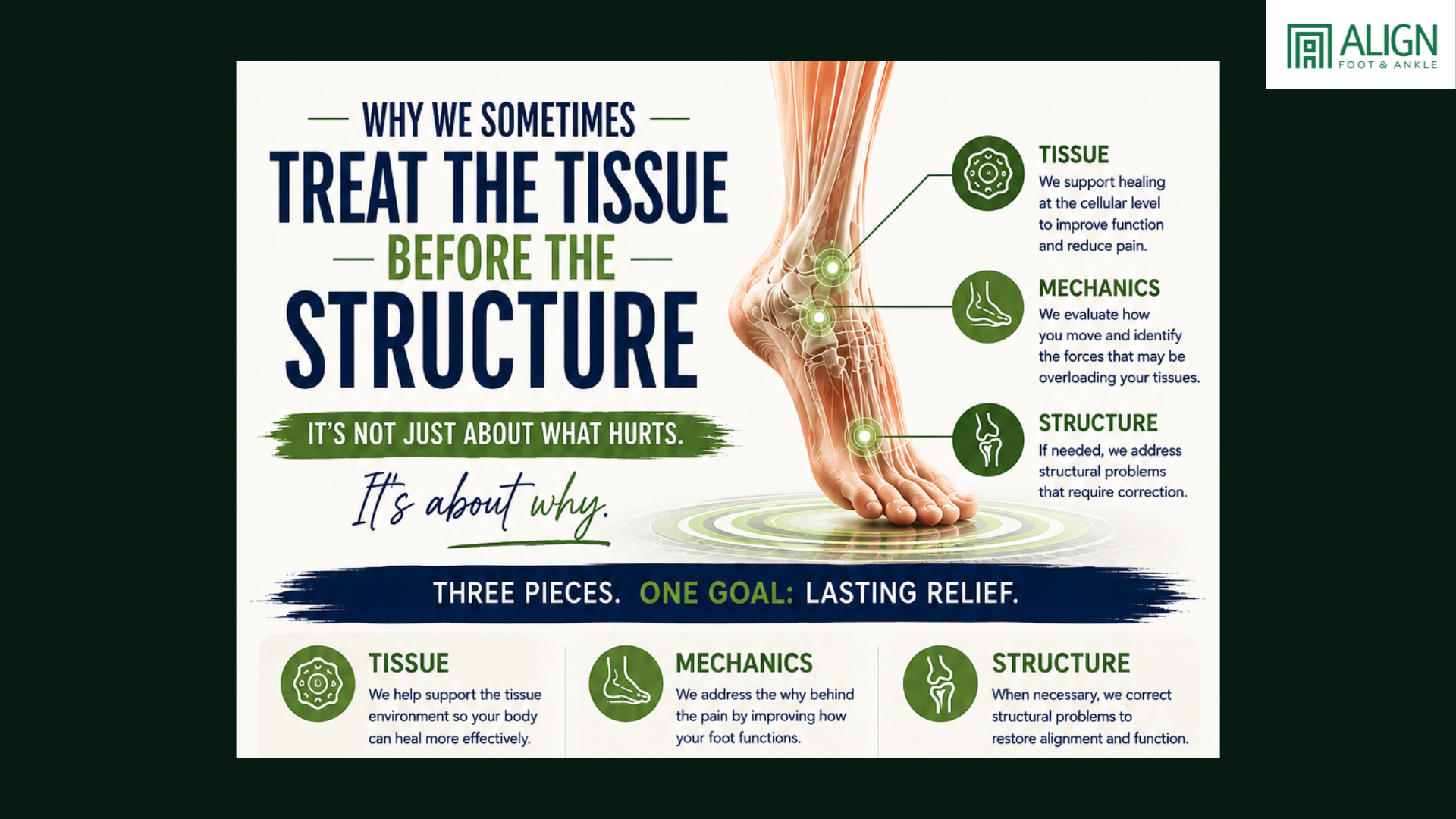
Tissue. Mechanics. Structure.
Sometimes we start by improving the tissue environment.
At the same time, we address the biomechanics that may be contributing to the injury.
And if the structure ultimately needs to be corrected, we have minimally invasive surgical options available when appropriate.
It’s not about avoiding surgery.
And it’s not about using regenerative medicine on everyone.
It’s about choosing the right treatment, for the right problem, at the right time.
Because sometimes the most important question isn’t:
“How do we fix what’s hurting?”
It’s:
“Why is it hurting in the first place?”
And that’s often where better treatment begins.
Schedule a consultation today.
Contact Align Foot & Ankle
• Phone: 512-882-4911
• Location: 1600 W 38th St #408, Austin, TX 78731
Don’t forget to check out our socials for valuable insights and updates:
• Tiktok